|
|
- Blog |
- IBM’s Project Bob and DBmaestro – A Match Made in Heaven


Agentic Database DevOps
IBM’s Project Bob and DBmaestro – A Match Made in Heaven

There is a moment in every technology shift where things stop being theoretical and start becoming real.
For AI in software development, that moment is happening now.
For the past couple of years, we have all experimented with AI assistants. They helped us write code faster, suggested fixes, generated snippets, maybe even wrote entire functions. Impressive, yes. Transformational, not quite.
Because at the end of the day, nothing really changed.
Developers still made the decisions.
Pipelines still executed the changes.
Production was still protected by human-controlled gates.
Then comes IBM Project Bob, and suddenly the conversation shifts.
Not from how AI helps developers, but from how AI participates in delivery.
IBM Project Bob is not just another coding assistant. It represents a different philosophy. Instead of focusing on code generation alone, it focuses on intent, context, and execution.
You describe what you want.
The system understands your environment.
It generates, reviews, and prepares change.
And increasingly, it doesn’t stop there.
It acts.
It interacts with systems, triggers workflows, and moves change forward across the software lifecycle. That shift, from suggestion to execution, is what makes Bob fundamentally different.
And also what makes it risky.
To enable this new capability, a new layer is emerging: Model Context Protocol, or MCP.
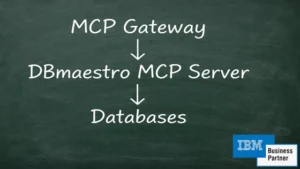
MCP is not flashy, but it is one of the most important building blocks in this new world. It defines how AI systems can interact with real-world tools and environments. Through MCP, systems like Bob can reach beyond the editor and into the organization itself, calling APIs, triggering pipelines, and executing actions.
In simple terms, MCP allows AI to move from “I recommend” to “I will do.”
And that is where things become very real, very fast.
Now imagine this new world in practice.
Bob analyzes a change request. It generates the required code. It validates the logic. It prepares deployment steps. Everything flows smoothly, efficiently, almost frictionless.
Until it reaches the database.
And suddenly, the pace changes.
Someone needs to review the schema. Someone needs to run scripts. Someone needs to validate dependencies. Someone needs to worry about rollback.
Because databases are different.
They are not just another layer in the stack. They are the system of record. They carry state, history, and business truth. They are shared across teams, tightly coupled to applications, and heavily regulated in many industries.
Breaking application code is inconvenient. Breaking a database can be catastrophic.
So even in the most advanced DevOps environments, the database remains the last manually controlled frontier. And in an AI-driven world, that frontier becomes more than a bottleneck. It becomes a risk multiplier.
Because now you have a system that can generate and push change faster than ever, while the most critical layer still relies on manual control.
This is where DBmaestro, an IBM strategic partner, enters the story.
DBmaestro recently launched its MCP integration. At first glance, it sounds like another integration point. Another technical capability.
But in reality, it represents something much more fundamental.
It positions DBmaestro as a native participant in AI-driven workflows. More precisely, it turns DBmaestro into what can be described as a database MCP server.
This means that DBmaestro exposes its capabilities as structured tools that AI systems like IBM Project Bob can call directly.
Now the flow changes.
Bob identifies a required schema change. It evaluates the impact. And instead of stopping or handing off to a manual process, it invokes DBmaestro.
Validate this change.
Check for drift.
Enforce policies.
Deploy safely to production.
And DBmaestro executes.
But not blindly.
It applies governance. It enforces policies. It validates dependencies. It controls execution. It produces a full audit trail.
This is the difference between automation and control.
Automation is easy. Control is hard.
And in enterprise environments, control is everything.
Because the real barrier to adopting AI-driven delivery is not capability. It is trust.
Can you trust an AI to modify your production database?
Can you trust it to respect access controls?
Can you prove what happened to an auditor?
These are the questions that matter to R&D leaders, CISOs, and data architects.
And this is exactly where DBmaestro fits.
It does not try to replace the intelligence of IBM Project Bob. It complements it. Bob provides reasoning, context, and decision-making. DBmaestro ensures that execution happens within strict boundaries.
Every database action, whether initiated by a human or by AI, becomes controlled, traceable, and reversible.
For years, DevOps has had an uncomfortable truth. We automated the application layer. We automated infrastructure. But the database remained behind.
Not because it was ignored, but because it was difficult.
Difficult to version.
Difficult to test.
Difficult to rollback.
Difficult to govern.
So organizations adapted. They built workarounds. They accepted delays. They relied on experts and manual processes.
It worked, more or less.
But in a world where AI accelerates everything upstream, that gap becomes impossible to ignore.
DBmaestro closes that gap by bringing the database into the same automated, governed delivery flow.
And when connected to IBM Project Bob through MCP, it does something even more important.
It ensures that the last mile of delivery is no longer the weakest link.
If you take a step back, what is happening here is bigger than any single product or integration.
We are moving from assisted development to autonomous systems.
Systems that can detect issues, propose solutions, execute changes, and validate outcomes.
But autonomy without control is chaos.
And control without automation is friction.
What IBM Project Bob and DBmaestro create together is a balance between the two.
A system where change can move fast, but never without guardrails.
A system where execution is automated, but never uncontrolled.
A system where innovation does not come at the expense of stability.
For developers, this means fewer bottlenecks and faster feedback loops.
For heads of R&D, it means scaling delivery without scaling risk.
For CISOs, it means visibility, control, and auditability at the most sensitive layer.
For data architects, it means preserving integrity while enabling continuous evolution.
But beyond roles and responsibilities, this represents a deeper shift.
A shift in how we think about software delivery itself.
IBM Project Bob represents the future of how software is built.
DBmaestro ensures that this future can operate safely in the real world.
If Bob is the brain that decides what should happen next, DBmaestro is the control system that ensures it happens safely.
And that is why this is not just a technical integration.
It is a natural alignment.
A necessary one.
A match made in heaven.
Get your demo now
Related Articles