

Database DevOps Observability.
If we can measure it, you can improve it.
DBmaestro’s DevOps observability platform connects the dots across your Database DevOps data - turning activity, metrics, and events into actionable insights. Gain a clear understanding of performance, risk, and compliance with DORA metrics, compliance visibility, and anomaly alerts in one place.

DBmaestro is trusted by the world’s leading enterprises






What is database DevOps observability?
Database DevOps observability is the ability to understand what’s happening across your database delivery process - from changes and deployments to compliance, performance, and production health. By connecting signals from across the lifecycle, it turns fragmented data into a unified view of trends, risks, and anomalies, so teams can quickly understand what needs attention.
DORA™-driven DevOps Observability Performance Dashboard
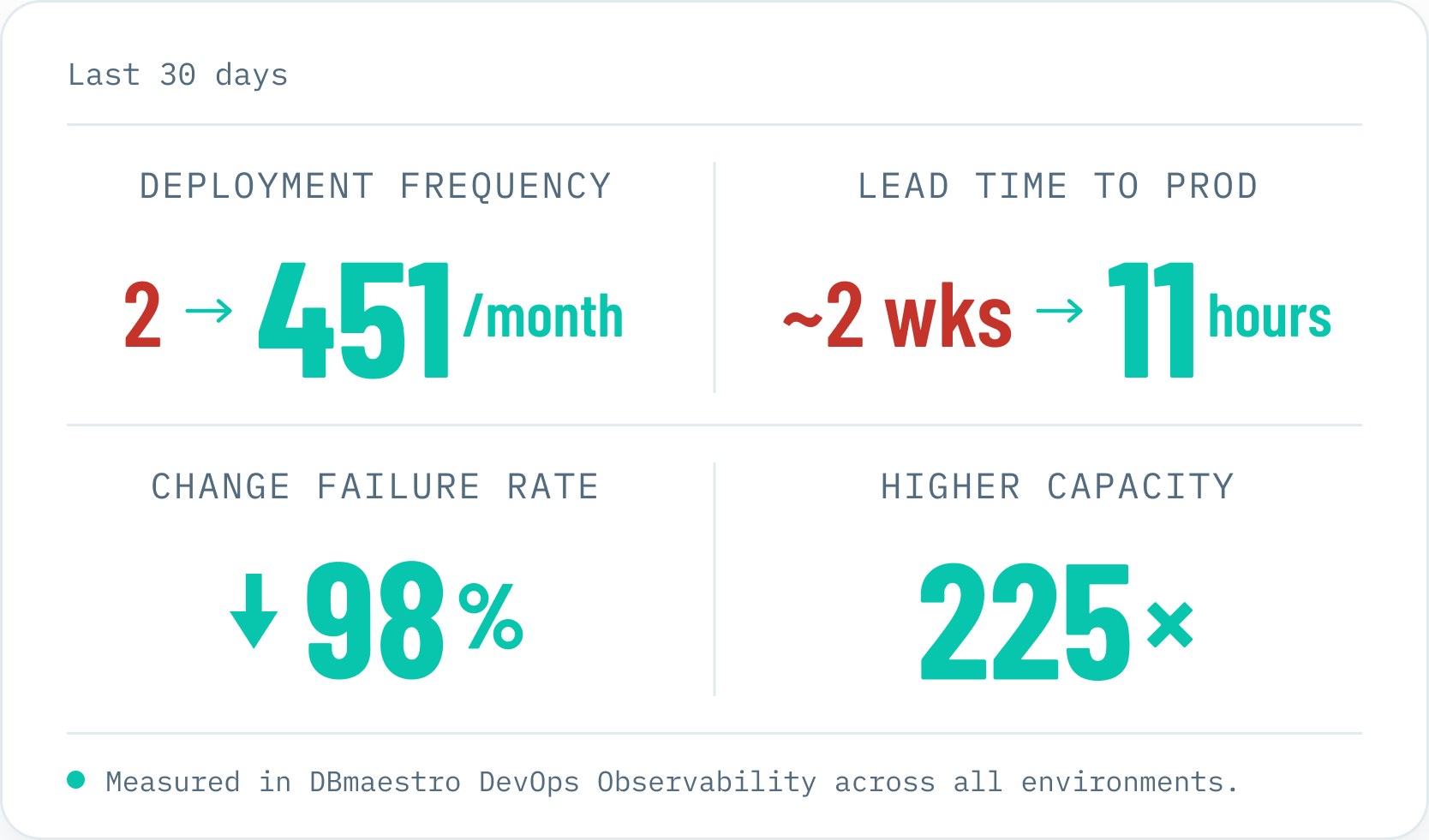
Understand your DevOps performance through deployment lead time, change failure rate, and other key DORA metrics - automatically measured and benchmarked, not calculated by hand. Identify trends over time, compare performance across teams and environments, and uncover where bottlenecks or instability are holding delivery back.
DORA metrics
CURRENT PERFORMANCE BAND
What DBmaestro’s customers are saying
DBmaestro works with the world’s leading companies across a wide range of regulated industries.


DBmaestro allows us to enforce that whatever goes to production is the same package, the same code, the same release that went into dev or QA. As soon as we give an application, a pipeline takes minutes - and it took hours and days before.
Pilot Flying J
John Ekka
DevOps & Automation Lead
Enterprise · >30,000 emp. Read Success StoryWe started with one manual release every three weeks - now we’re at 2,300 releases per month.
DevOps & Site Reliability
Enterprise · >1,000 emp. Read Success StoryDevOps and data warehouses have a bright future together with DBmaestro.
 Université de Lausanne - UNIL
Paulo Monteiro
Université de Lausanne - UNIL
Paulo Monteiro
Software & Data Engineering Manager
Enterprise · >1,000 emp. Read Success StoryDBmaestro allowed us to control changes made to the database and promote those changes in an easy and controlled way.
Elevance Health
Tim McKean
Data Architect, Elevance Health
Enterprise · >1,000 emp. Read Success StoryBy embedding DBmaestro’s database DevOps suite into our ecosystem, we’re removing one of the last barriers to true end-to-end DevOps.
 IBM DevOps Automation
Strategic Business Partner
Read Success StoryExtend Database DevOps Observability Your Way
Build custom observability dashboards with AI. Use DBmaestro’s Observability AI dashboard generator to turn your data into tailored views, insights, and KPIs for different teams and use cases.
Connect DBmaestro observability to your existing stack - use OpenTelemetry to integrate DBmaestro with your broader observability platform and bring database DevOps signals into the tools your teams already use.
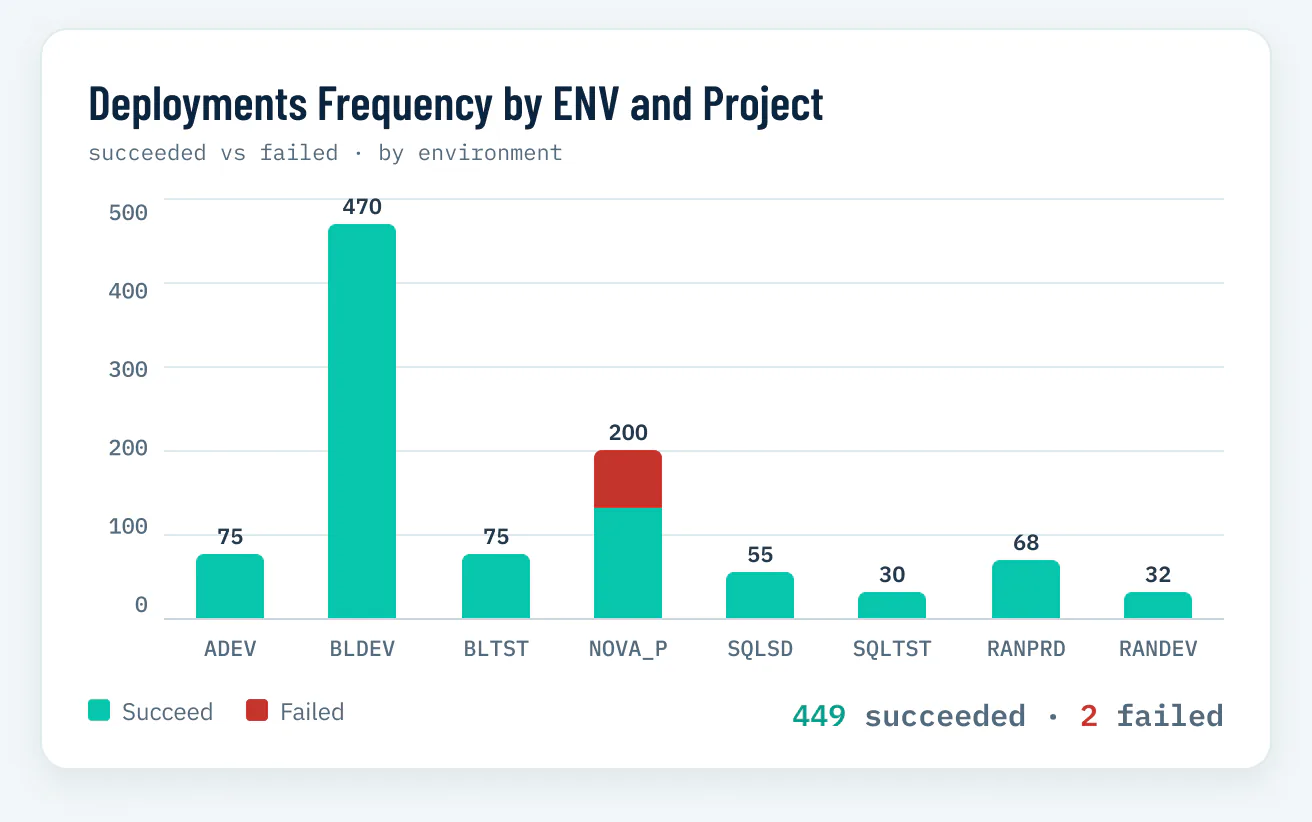
Identify roadblocks and bottlenecks
Track deployment frequency per environment and project to identify outliers, focus on struggling areas, and allocate resources where they matter most.
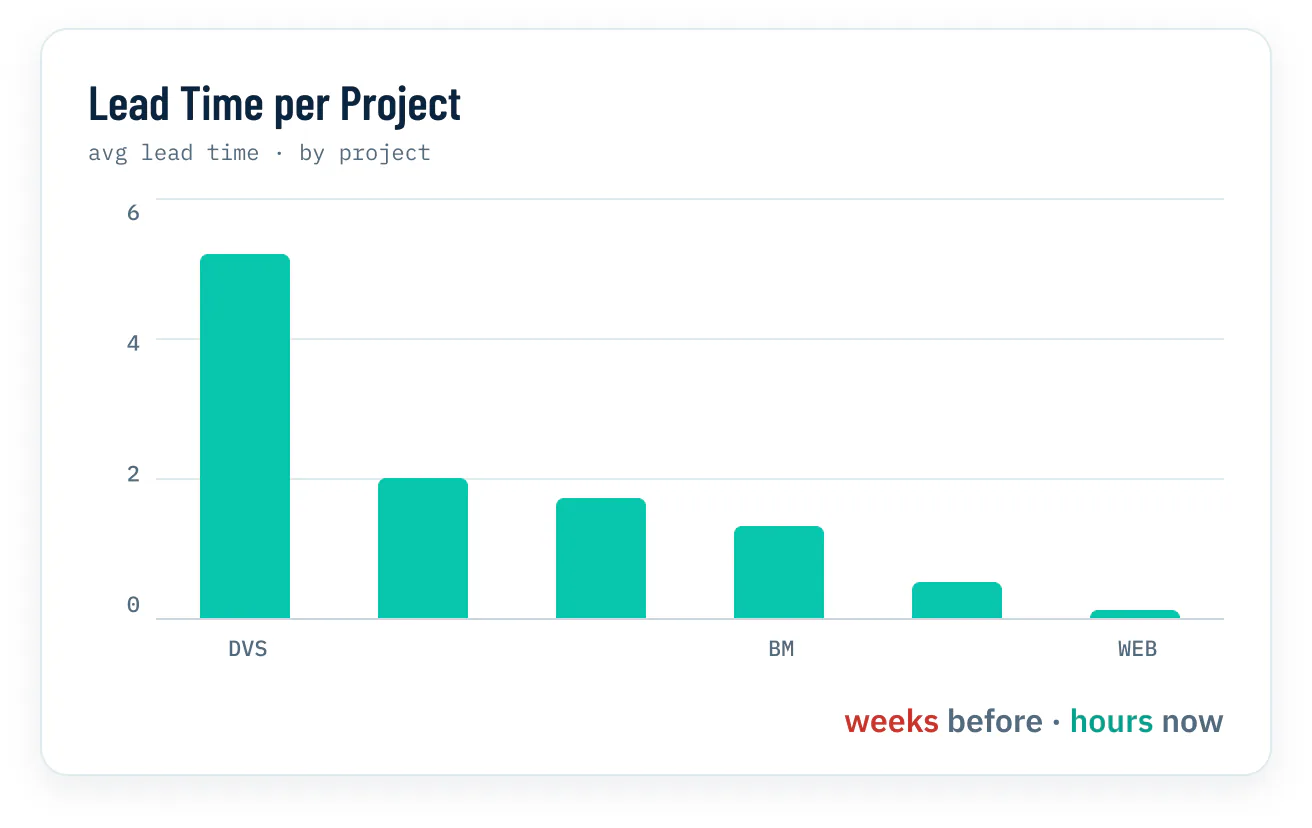
Accelerate the slowest-moving parts
Trace delays to the bottleneck stage - identify the teams and projects that need support, and address issues before they impact delivery.
Key Benefits - What do teams get from database DevOps observability
- Complete visibility across database delivery
- Lower change failure rates through earlier insight
- Faster detection and recovery from issues
- Continuous improvement backed by data
- Consistent DevOps performance metrics across every team
- Audit-ready evidence for compliance reviews
Works across





FAQ
-
Can DBmaestro’s database DevOps observability help identify process bottlenecks, not just technical issues?
Yes. DBmaestro’s database DevOps observability data can highlight delays in approvals, testing stages, or deployment cycles, revealing workflow inefficiencies beyond pure performance problems.
-
Does DBmaestro’s database observability require changes to application code?
No. DBmaestro’s database DevOps observability can be implemented without modifying application code, making it suitable for legacy and third-party systems.
-
Can DBmaestro’s database DevOps observability data be shared across teams securely?
Yes. DBmaestro’s role-based access ensures that DevOps, DBAs, and managers see relevant insights without exposing unnecessary technical or sensitive details.
-
How does DBmaestro’s database DevOps observability support capacity planning?
DBmaestro’s database DevOps observability of historical trends and usage patterns help teams anticipate growth, optimize resource allocation, and prevent performance degradation before it impacts users.
-
What is database DevOps observability?
Database DevOps observability is always up-to-date visibility into every database change and deployment, so teams can measure delivery performance, spot bottlenecks, and reduce release risk. It combines telemetry from CI/CD pipelines, schema migrations, and runtime environments to show how fast and safely databases move from commit to production - the database-specific layer of DevOps observability that complements application and infrastructure monitoring.
-
How is database observability different from database monitoring?
Monitoring focuses on database performance and uptime. Database DevOps observability adds deployment activity, team productivity, and compliance data to show the full release process, not just runtime health.
-
Which DORA metrics can I track for database deployments?
You can track all core DORA metrics for database work: deployment frequency, lead time for changes, change failure rate, and failed deployment recovery time. For databases, this means measuring how often schema or code changes reach production, how long they take from commit to deploy, how many cause incidents or rollbacks, and how quickly teams recover. Some implementations also include deployment rework rate to capture unplanned fixes triggered by production issues.
-
How does database observability help identify bottlenecks in releases?
Database observability highlights where changes slow down or fail by correlating deployment events with duration, approval wait times, and failure patterns across environments. You can see which teams, databases, or schema migration types have the longest lead times, highest failure rates, or most rework, then focus improvement efforts there. Over time, this turns raw release data into clear targets for speeding up safe database delivery.
-
Can I use this to reduce database release risk without slowing down deployments?
Yes. Database DevOps observability reduces release risk by making risky patterns visible - frequent emergency changes, high change failure rates, long recovery times - so you can address root causes instead of adding blanket gates. Teams use these insights to tighten testing on high-risk change types, improve rollback strategies, and standardize safer schema change patterns, which lowers failure rates while maintaining or improving deployment frequency.
-
Who should use database DevOps observability in my organization?
Database DevOps observability is for DevOps and platform engineers, DBAs, and engineering leaders who own database delivery performance and release risk. DevOps and platform teams use it to instrument pipelines and standardize metrics; DBAs use it to understand change impact and stability; engineering leaders use it to track DORA metrics by team and environment and prioritize improvements.
Measure it. Then improve it.
A 30-minute walkthrough on your databases, your environments, your metrics.