|
|
- Blog |
- In Proof We Trust: What Mathematics Teaches Us About Determinism in Database DevSecOps


Database Compliance Automation
In Proof We Trust: What Mathematics Teaches Us About Determinism in Database DevSecOps


In mathematics, belief does not matter.
Confidence does not matter. Intentions do not matter. Experience does not matter.
Only proof matters.
A theorem is either proven or it is not. An equation either balances or it does not. A function either produces the same output for the same input, or it fails.
Mathematics does not tolerate ambiguity.
At enterprise scale, neither should governance.
Modern software delivery operates at extraordinary velocity. Continuous integration, distributed teams, frequent releases, automated testing. Everything is optimized for speed.
Yet the database remains the system of record. Financial data. Customer history. Regulatory evidence. Business logic. What changes there carries consequence.
And still, many organizations manage database change on confidence rather than proof.
“We reviewed it.”
“It passed testing.”
“It should be compliant.”
Should is not mathematical.
In high-scale, regulated environments, should is not enough.
Determinism Eliminates Interpretation
In mathematics, a deterministic function guarantees that identical inputs produce identical outputs.
There is no interpretation layer. No variation based on who executes it. No dependency on memory or context.
The result is predictable.
Now consider database change without structural enforcement.
One team deploys manually.
Another environment applies a slightly different script.
A permission is configured differently under deadline pressure.
The system may still operate. But it is no longer deterministic.
It depends on interpretation.
Interpretation introduces variability. Variability introduces risk. Risk slows delivery.
Determinism removes interpretation.
That is the standard Database DevSecOps must achieve at the system of record.
Invariants Under Pressure
In mathematics, invariants are properties that remain constant even as systems transform.
No matter how complex the equation becomes, certain truths hold.
Enterprise governance needs invariants.
Separation of duties must hold under velocity.
Policy enforcement must hold under deadline pressure.
Audit evidence must exist regardless of who deploys the change.
When governance relies on discipline alone, it fluctuates under stress.
When governance is embedded structurally, it holds.
That is the difference between guidance and proof.
When Governance Becomes Structural
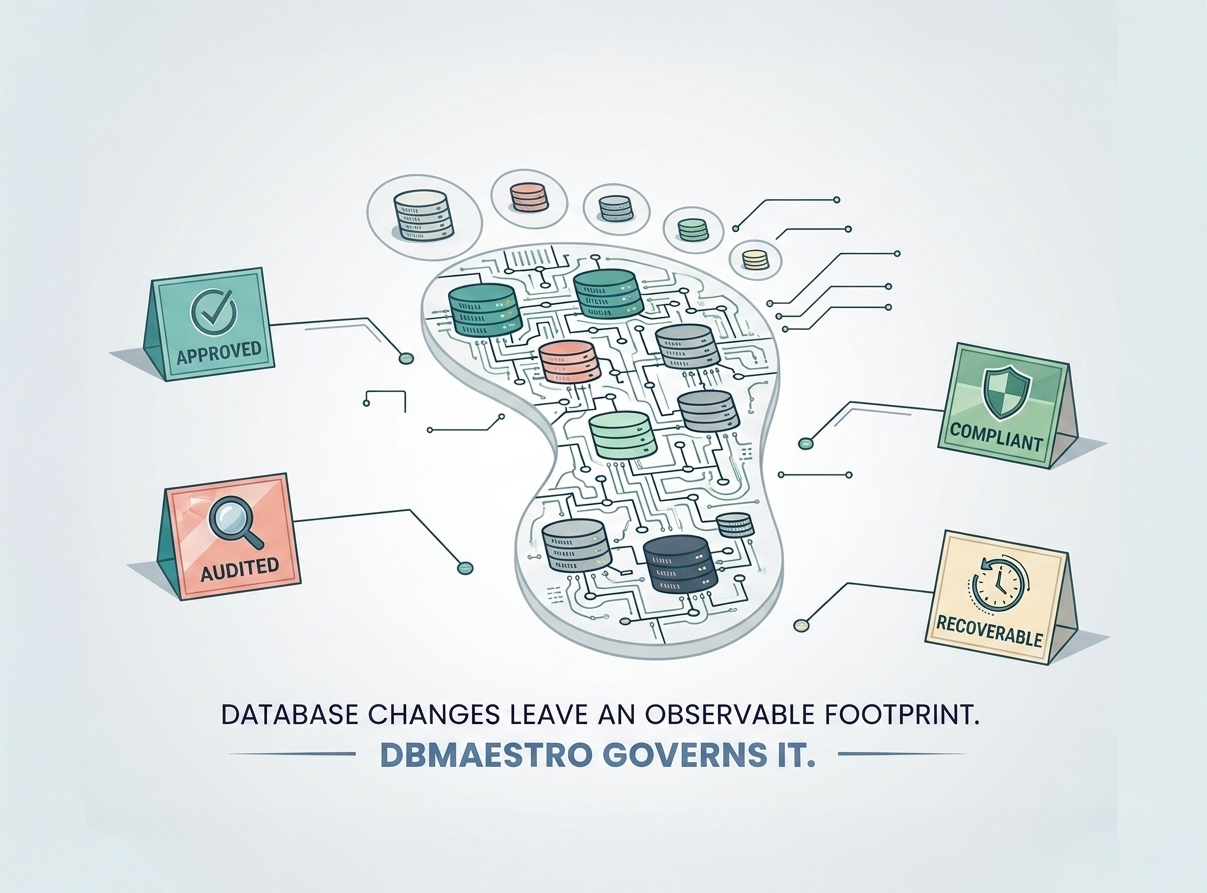
DBmaestro turns database governance into a deterministic system.
Every change is versioned and traceable. Promotion paths follow defined rules. Policy validation occurs automatically before deployment. Violations are blocked by the system. Rollback paths are engineered into the lifecycle.
The outcome does not depend on who performs the deployment.
The same input produces the same output.
That is determinism.
When enforcement becomes deterministic, confidence shifts from assumption to proof.
Proof at Enterprise Scale
Mathematical proof does not weaken with repetition. If it holds once, it holds at scale.
Enterprise systems require that same reliability.
One database can be governed manually. Hundreds cannot.
Customers describe this shift clearly.
One enterprise team shared that before implementing DBmaestro, database deployments were manual and prone to error. After adoption, they established a structured database DevOps practice and consistently delivered accurate database schemas and code .
Another large financial institution integrated DBmaestro directly into its Azure DevOps pipeline. Manual intervention was eliminated. Failures now trigger immediate feedback loops back to development, accelerating troubleshooting and strengthening release reliability .
This is not cosmetic automation.
Manual judgment became automated validation.
Deployment variability became consistent execution.
Reactive troubleshooting became built-in feedback.
The system began behaving like a proof.
Binary Confidence
Mathematics does not allow “almost correct.”
An equation either balances or it fails.
Database DevSecOps must operate under the same discipline.
A change either complies with policy or it does not.
Access either respects defined roles or it does not.
Promotion either follows the approved path or it is blocked.
Binary enforcement removes gray zones.
When enforcement is structural and automated, governance becomes predictable. Predictability reduces fear. Reduced fear increases velocity.
Speed and certainty stop competing.
They reinforce each other.
The Takeaway
Trust in mathematics comes from proof.
Not from belief. Not from review. Not from confidence.
Proof.
That is the standard enterprise database governance must reach.
From DBmaestro, you can expect database change that behaves deterministically. You can expect policy enforcement that is consistent regardless of environment or operator. You can expect compliance evidence that exists by design rather than reconstruction.
When governance becomes structural, scale becomes manageable.
When enforcement becomes invariant, velocity becomes sustainable.
Mathematics teaches that certainty is not emotional.
It is engineered.
In Database DevSecOps, that engineered certainty is what transforms control into confidence.
And in environments where data carries consequence, confidence built on proof is the only kind that lasts.
Get your demo now