



Observability has matured. For many organizations, it is no longer about uptime and alerts but about understanding system behavior, supporting decisions, and reducing uncertainty across complex environments.
Metrics, logs, traces, and events are everywhere. Applications are instrumented, infrastructure is mapped, pipelines expose delivery performance, and dependencies are visualized in real time. On paper, the stack looks observable.
In practice, a critical layer is still missing.
When incidents happen, audits begin, or risk must be explained, teams often realize that the most important part of the system was never truly observable. The database.
Not the database as a runtime service. Latency, availability, and resource usage are usually visible. The real blind spot is elsewhere.
Database change.

Where observability breaks
Most failures today are not detection problems. They are explanation problems.
A release goes out and performance degrades. Application metrics spike, infrastructure looks stable, the network shows nothing unusual. Eventually, someone asks the inevitable question: did anything change in the database?
That is usually where confidence drops.
Database changes often live outside the observable system. They are executed through scripts, tickets, emails, or manual DBA workflows. Even in organizations with mature CI/CD, database change is frequently treated as an exception rather than a first-class delivery activity.
From an observability standpoint, this is fatal. You cannot correlate what you cannot see, and you cannot explain system behavior if the most consequential changes were never captured as structured events.
This is how observability becomes fragmented. Not because data is missing everywhere, but because context is missing exactly where risk concentrates.
Fragmentation is structural, not a tooling issue
Most enterprises already collect more telemetry than they can reasonably consume. Adding more dashboards does not solve the problem.
The issue is historical. Database change management evolved outside the delivery platform. Unlike application code, database changes were optimized for safety through human control, not for transparency through automation.
Over time, this created a blind spot.
Architects struggle to reason about cause and effect across layers. DevOps leaders cannot confidently connect governance with delivery outcomes. DBAs become bottlenecks, not by choice, but because they are the only ones who can reconstruct what happened. Security and compliance teams compensate with manual reviews and documentation.
Everyone is working hard, yet the system becomes harder to understand.
That is the opposite of what observability is meant to achieve.
Why traditional observability cannot close the gap
It is tempting to assume this gap can be closed with better monitoring. More logs. Longer retention. Smarter alerts.
That assumption misses the point.
Database DevSecOps observability is not primarily about runtime behavior. It is about change behavior. Intent, enforcement, and evidence.
You cannot infer who approved a schema change from CPU metrics. You cannot prove separation of duties from query logs. You cannot reliably reconstruct policy enforcement after the fact.
For database change to be observable, the signal must be produced at the moment change is defined and executed. If changes bypass structured control, observability becomes forensic rather than operational.
By then, it is already too late.
Database DevSecOps as an observability discipline
Database DevSecOps is often framed as a speed or compliance initiative. Those are outcomes, not the core value.
At its core, Database DevSecOps makes database change observable by design.
When changes are defined in code, validated automatically, approved through enforced roles, and executed consistently across environments, change stops being an opaque act and becomes a traceable system behavior.
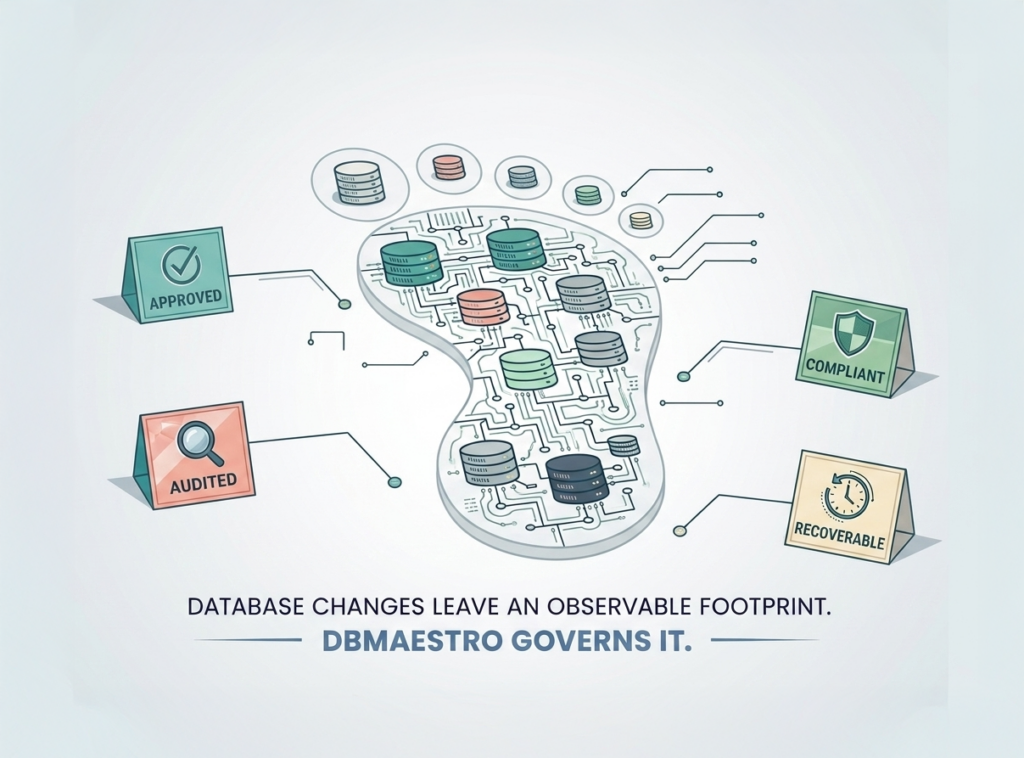
Every decision leaves context. Every policy leaves evidence. Every deployment leaves a footprint.
That is the missing layer of observability.
How DBmaestro closes the gap
This is the gap DBmaestro was built to close.
Instead of treating database change as a side process, DBmaestro places it inside a governed execution layer that is part of the delivery platform itself.
A database change is committed and versioned like application code. It flows through an automated pipeline that understands database semantics. Policies are evaluated automatically. Separation of duties is enforced structurally. Approvals are captured as part of execution.
As changes move across environments, DBmaestro records exactly what ran, under which role, and with which controls applied. If something is blocked, the reason is explicit. If an exception is granted, it is traceable. If a rollback is required, it is deliberate and reproducible.
Because DBmaestro sits in the execution path, it becomes the authoritative source of truth for database change behavior. Not inferred. Not reconstructed. Actual.
This is where observability stops being fragmented.
Closing thought
Observability exists to reduce uncertainty. As long as database change remains invisible, uncertainty remains built into the system.
Making database change observable, governed, and explainable closes the last major gap in enterprise observability and replaces assumptions with evidence.
Frequently Asked Questions
1. How is "Database Observability" different from standard Database Monitoring?
Traditional monitoring focuses on health and performance: metrics like CPU spikes, memory usage, and slow query logs. It tells you that something is wrong. Database DevSecOps Observability focuses on change and intent. It tells you why something changed, who authorized it, and how it aligns with your security policies. It bridges the gap between a performance dip on a dashboard and the specific schema migration that caused it.
2. We already use CI/CD for our applications; why isn't that enough?
Application CI/CD is designed for stateless code. Databases are stateful and persistent. When you push a bad application build, you can simply roll back to a previous container image. When you push a destructive database change, you risk data loss or corruption. Standard CI/CD tools don't understand database semantics (like dependencies or table locks), which is why database changes often fall back into manual, "unobservable" workflows.
3. Can’t we just use our existing logs (Splunk, ELK, etc.) to track database changes?
Logs are forensic: they tell you what happened after the fact, often in a fragmented, hard-to-parse format. They rarely capture the business context, such as which Jira ticket requested the change or which policy was bypassed. True observability requires the change to be captured as a structured event at the moment of execution, linking the "who, what, and why" in a way that logs alone cannot.
4. How does making database changes observable improve security and compliance?
Compliance often fails because of "blind spots" where manual overrides occur. By making the database change process observable, you create an automated, immutable audit trail. You can prove Separation of Duties (SoD) and policy enforcement (like "no plain-text passwords" or "no DROP commands") without having to manually reconstruct history during an audit.
5. Does adding this layer of observability slow down the delivery pipeline?
Actually, it’s the opposite. Uncertainty is the biggest bottleneck in DevOps. When changes are opaque, DBAs must perform manual reviews to ensure safety, which creates delays. By using a platform like DBmaestro to make changes observable and governed by design, you can automate those reviews. Teams move faster because the "safety net" is built into the visibility layer.