|
|
- Blog |
- Are you stuck reacting to your database?


Database CI/CD
Are you stuck reacting to your database?

Are you stuck reacting to your database?
Modern databases have never been more powerful, or more dangerous. Over the past two decades, organizations have eagerly adopted cloud databases, NoSQL, NewSQL, managed services, and specialized data stores for analytics, caching, search, and AI workloads. At the same time, the people who traditionally acted as the safety net for all this complexity, database administrators (DBAs), have become dramatically outnumbered.
In the year 2000, there were roughly 639,000 software developers and 108,000 database administrators, a ratio of about 6 developers for every DBA. By May 2023, the gap had widened dramatically, with about 1,656,880 software developers versus just 76,140 traditional DBAs, or 22 developers for every DBA. That shift tells a clear story, databases got more complex, while dedicated database oversight shrank.
When issues move from “caught early” to “caught in production”
In the world where DBAs were deeply embedded in teams, problems were often intercepted long before they reached customers. A seasoned DBA would:
- Spot a missing or misused index before it turned into a slow motion production meltdown.
- Push back on a risky schema change that would not scale with the expected workload.
- Identify when a new feature’s access pattern was a bad fit for the chosen database technology.
These interventions usually happened during design reviews, deployment planning, or early testing. The cost of fixing the issue was low, the impact minimal, and the learning immediate.
Today, with one DBA supporting multiple teams, or no DBA at all, those same problems often go unnoticed until they manifest as:
- Sudden spikes in latency during peak traffic.
- Migrations that lock critical tables and block writes.
- Cascading failures when one overloaded data store slows down everything that depends on it.
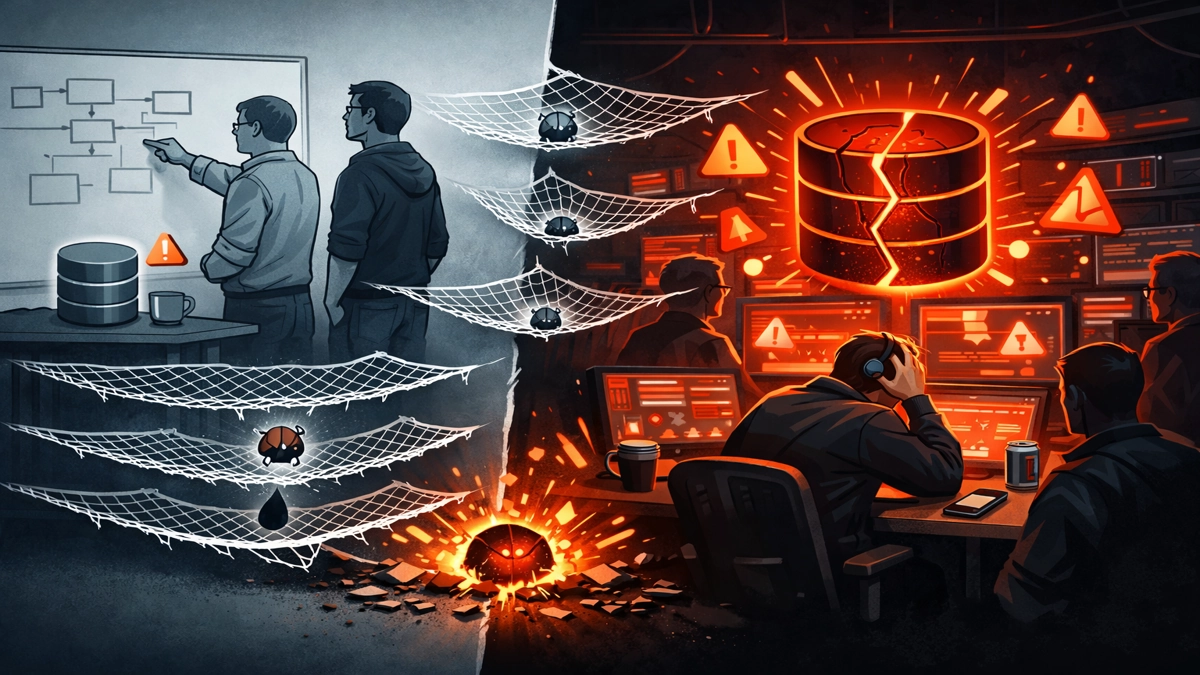
What used to be a quiet conversation at a whiteboard has turned into an incident call at 3 a.m.
Complexity is up, oversight is down
At the same time that DBA headcount has not kept pace, database complexity has exploded. A typical modern application might use:
- A relational database for core transactional data.
- A key value or document store for session data or high velocity writes.
- A search engine for text queries.
- A data warehouse or lake for analytics.
- A specialized store for time series, graph, or vector data.
Each of these technologies brings its own performance characteristics, configuration pitfalls, and failure modes. Yet the people designing, changing, and deploying them are often application developers under intense delivery pressure, not database specialists with years of experience.
The result is a growing “risk gap” between what teams are changing in their databases and what anyone is actually watching.
Why traditional processes are no longer enough
Many teams try to close this gap with code review, peer review of migration scripts, or some production monitoring. Those practices are important, but they have limits:
- Code reviewers rarely have deep expertise in every database engine in the stack.
- Reviews tend to focus on application logic, not subtle performance or locking behaviors in DDL and DML.
- Monitoring catches symptoms after the fact, it does not prevent risky changes from being deployed.
Without a dedicated DBA, teams effectively move from prevention to reaction. Issues are discovered not because someone anticipated them, but because customers, dashboards, or error budgets reveal the damage.
How DBmaestro steps into the gap
This is where DBmaestro’s AI-driven database DevOps comes into play. Instead of relying solely on scarce human specialists, DBmaestro acts as an automated guardian over your database changes, continuously analyzing what is about to be deployed and how it might behave.
DBmaestro’s approach can:
- Automatically inspect database changes, such as schema modifications, stored procedures, and data affecting scripts for bugs, errors or risky patterns, and use AI to offer solutions when an issue is detected.
- Enforce policies and best practices that a good DBA would insist on, consistently, across teams and environments.
- Integrate with existing CI/CD pipelines so database checks happen alongside application checks, before anything reaches production.
In essence, DBmaestro functions like the experienced DBA who never sleeps, never skips a review, and always has the full picture of what is changing across databases and environments.
From firefighting to prevention
When risky changes are caught early, during development or in a pre production environment, the economics and stress profile of database work change completely:
- Developers receive clear feedback while context is fresh, making fixes faster and cheaper.
- Ops and SRE teams see fewer “mystery” incidents rooted in silent database changes.
- Product teams maintain delivery velocity without constantly fearing the next database related outage.
Instead of letting issues “announce themselves” in production through downtime and customer impact, DBmaestro helps surface and remediate them when they are still just potential risks.
Intelligent guardrails for a high velocity world
The developer to DBA ratio shift from 6:1 to 22:1 is not just a labor statistic, it is a structural change in how software is built and run. More developers are shipping more changes to more databases, with fewer experts available to oversee them. Human only processes cannot realistically scale to that reality.
That is why intelligent, automated guardrails around database delivery are no longer a luxury. With hundreds of database technologies in play and shrinking human oversight, teams need systems that:
- Understand database change, not just application code.
- Apply consistent, expert level scrutiny to every deployment.
- Turn database safety from a best effort manual task into a built in property of the pipeline.
DBmaestro’s AI-driven database DevOps is built to provide exactly that. By acting as the always on, always vigilant stand in for the missing DBA on your team, it helps you ship fast, innovate confidently, and avoid learning about database problems only when they have already become outages.
Get your demo now