



In chemistry, the most dangerous reactions are not the large ones.
They are the uncontrolled ones.
A chain reaction rarely begins with an explosion. It starts quietly. A bond shifts. Energy is released. That energy destabilizes something nearby. Another bond changes. Then another. If nothing contains it, the reaction accelerates on its own.
Placed inside a controlled chamber, guided by the right catalyst, the same reaction becomes transformation.
Modern development teams operate inside constant reaction cycles.
A feature request leads to code.
Code requires a schema adjustment.
Schema changes affect reporting.
Reporting impacts analytics.
Analytics influences decisions.
One action rarely stays isolated.
Most organizations believe their challenge is speed. In reality, their challenge is reaction control.
The Quiet Start of Instability
Database incidents rarely begin dramatically.
They begin with something small. A table modification late in a sprint. A temporary permission granted for convenience. A hotfix applied directly in production to meet a deadline.
Individually, none of these actions feel catastrophic.
But chemistry teaches us that instability does not announce itself early. It escalates when reactions spread unchecked.
In software delivery, that spread looks like drift between environments, inconsistent deployments, hidden privilege expansion, and growing mistrust between teams.
Developers hesitate to touch the database.
DBAs tighten controls defensively.
Security adds manual review layers.
Compliance steps in after the fact.
Velocity slows not because talent is missing, but because confidence erodes.
The system becomes volatile.
Friction Is Not Stability
When reactions feel unstable, organizations often add friction.
More approvals. More documentation. More checkpoints between intent and execution.
This raises activation energy. Change becomes harder to initiate.
For a while, it feels safer.
But pressure builds. Releases grow larger. Risk concentrates. When change finally happens, it happens in heavier, more fragile batches.
Chemistry offers a different answer.
Instead of friction, introduce a catalyst.
A catalyst allows transformation to occur more predictably. It lowers the energy required for change while preventing destructive side reactions.
This is precisely what Database DevSecOps must achieve at the database layer.
The Database as Reaction Amplifier
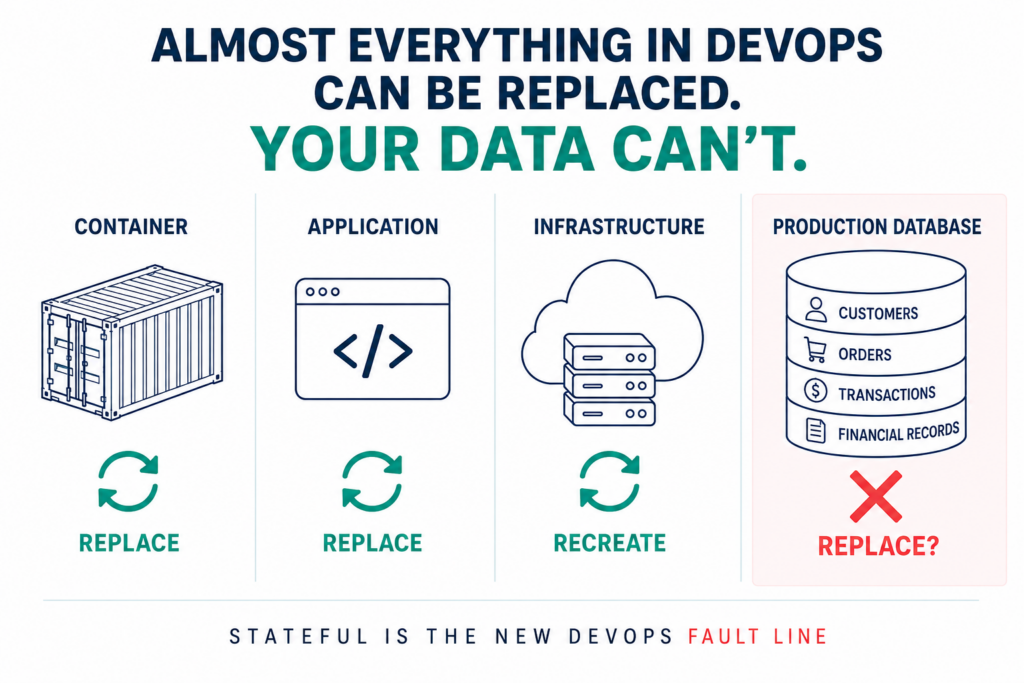
Application changes can often be isolated. Infrastructure can be reprovisioned. Containers can be redeployed.
The database is different.
It holds financial records, customer data, regulatory reporting structures, and operational logic. A small schema shift can ripple across services. A permission adjustment can affect multiple business units. Environment drift can surface months later during audit review.
The database amplifies reactions.
When teams sense that amplification, they grow cautious. Caution reduces collaboration. Reduced collaboration increases informal workarounds. Workarounds introduce side reactions.
The chemistry between teams destabilizes.
The issue is not change.
The issue is uncontrolled change.
Collaboration as Chemical Stability
Reactions depend on how elements interact.
In organizations, developers, DBAs, DevOps engineers, security leaders, and compliance teams are reactive elements. If their interaction relies solely on manual coordination and personal trust, complexity eventually destabilizes them.
When governance is embedded in the system, collaboration changes.
Developers know their changes will be validated automatically.
DBAs trust that policies are enforced consistently.
Security sees violations blocked before escalation.
Compliance receives continuous evidence instead of post-incident reconstruction.
The reaction chamber becomes structured.
Collaboration stabilizes because uncertainty is reduced.
DBmaestro as Catalyst
DBmaestro acts as both the reaction chamber and the catalyst for database change.
Every database modification becomes versioned and traceable. Separation of duties is enforced automatically. Drift is detected early. Rollbacks are engineered into the delivery lifecycle.
The governed path becomes the natural path.
By embedding policy enforcement directly into the CI/CD pipeline, DBmaestro lowers the energy required for compliant change. Developers do not negotiate every deployment manually. Security does not rely on retrospective audits. Compliance does not reconstruct history under pressure.
The reaction proceeds, but it remains controlled.
Transformation accelerates safely.
Preventing Side Reactions
In chemistry, side reactions waste energy and create unstable byproducts.
In enterprise delivery, side reactions appear as shadow scripts, emergency fixes, undocumented permission grants, and inconsistent environments.
They usually begin as attempts to bypass friction.
When the official path is complex, people create alternatives.
DBmaestro minimizes side reactions by making the governed path the easiest path. Violations are intercepted automatically. Policies are enforced consistently. Visibility is continuous.
Teams stop inventing unstable shortcuts.
The chemistry stabilizes.
What You Can Expect in Practice
This is not theory.
Enterprise customers describe the shift clearly.
One reviewer wrote on G2, “DBmaestro has delivered big for us and enabled us to launch a successful database DevOps practice. Prior to DBmaestro, all deployments were manual and error prone.” Another shared, “DBmaestro has solved our end-to-end CI/CD automation challenges. Integrating DBmaestro with Azure DevOps has taken our database code to market faster by streamlining the entire process with more frequent, reliable deployments.”
Those statements capture the chemistry.
Manual and risky becomes automated and traceable.
Drift becomes visible and eliminated.
Reactions become standardized rather than volatile.
What you can expect from DBmaestro is not the elimination of change.
You can expect controlled transformation.
You can expect visible governance.
You can expect collaboration without friction.
You can expect delivery that accelerates without destabilizing the system of record.
In chemistry, uncontrolled reactions destroy structures.
Controlled reactions build new ones.
Database DevSecOps depends on knowing the difference.
And the right catalyst makes all the difference.