


For a company like Pilot Flying J, precision and agility are a necessity. As North America’s largest fueling and travel center network, dynamic gas pricing and other real-time operational variables means that every mistake or miscalculation has significant real-world consequences, measured in the millions of dollars.
Intro: Who Is Pilot Flying J?
Pilot Flying J operates a widespread network of gas stations and travel centers serving individual drivers, professional truckers, and commercial fleets across North America. Beyond simply selling fuel, its locations provide services such as food, maintenance, and amenities that all rely on integrated systems and consistent data.
For a company like Pilot Flying J, data is the “new oil” - it powers core processes such as fuel pricing, inventory management, and customer-facing experiences. If that data becomes inconsistent, if prices differ between pumps or systems, for instance, the impact is immediate: customers lose trust, operations slow down, and the brand’s reputation suffers. As a result, the way database changes are delivered, validated, and governed has direct implications for customer satisfaction and long-term business stability.
Their Database Release Challenges
Over time, Pilot Flying J’s application landscape evolved to embrace modern DevOps practices. Teams adopted microservices and serverless patterns, and application deployments became faster and more frequent thanks to mature CI/CD pipelines and infrastructure automation. In many cases, developers could deliver application components or updates on demand, moving from ideation to production within a day.
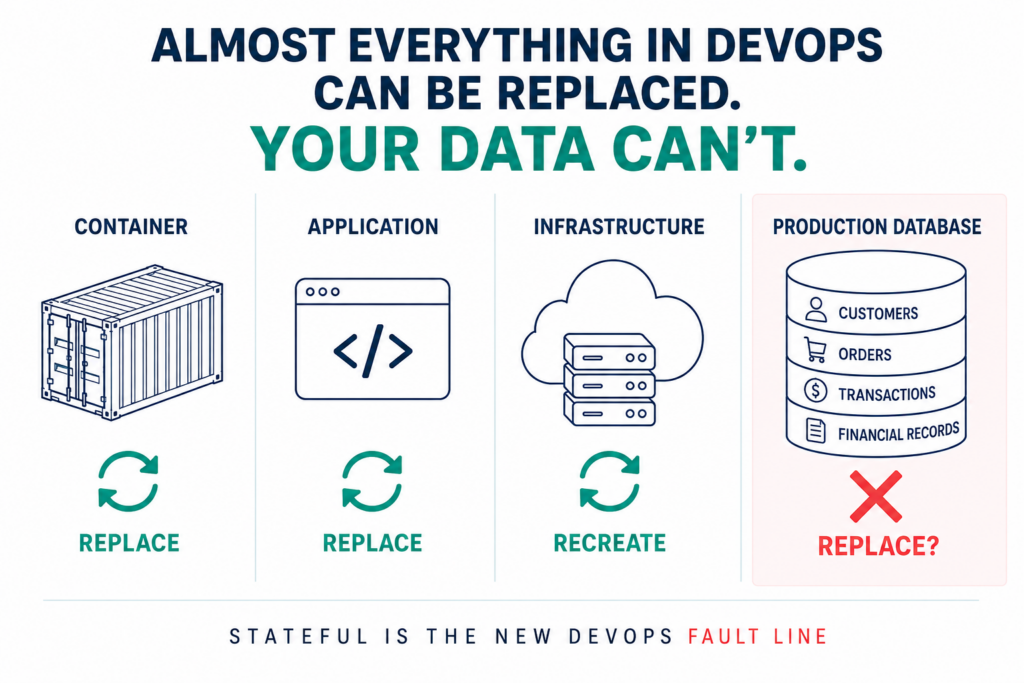
Unfortunately, database releases were not included. Changes to schemas, stored procedures, and reference data still relied heavily on manual scripts that were passed around through tickets, emails, shared folders, or chat messages. Each change had to be executed individually, environment by environment, with DBAs manually reviewing and running scripts and then validating results. This mismatch created a clear gap: while applications moved at light speed, database changes were stuck in a quagmire, limiting how fast new features or improvements could be delivered end to end.
As a result, the DBA team was seen to be a roadblock - even though the underlying issue was process and tooling rather than people. A relatively small group of DBAs was responsible for supporting dozens of database deployments every week, across multiple systems and environments. They were frequently interrupted, forced to switch context between strategic work and urgent deployment tasks, and asked to verify that each change was safe and compliant before it reached production.
This constant pressure created high cognitive load and made it difficult to scale reliably. Developers, on the other hand, felt constrained by long turnaround times and repeated back-and-forth with DBAs. Trust between teams could erode when issues occurred, even though everyone ultimately wanted the same outcome: fast, safe, and predictable database changes.
How Pilot Flying J Adopted DBmaestro
Pilot Flying J selected DBmaestro as its database DevOps platform after evaluating options in the market. The key reasons were its relative simplicity to learn and adopt, and its ability to provide a unified way of working across different database technologies used in the organization. Rather than forcing DBAs to maintain multiple tools and processes for each engine, DBmaestro offered a single interface and API layer to manage deployments consistently.
With DBmaestro in place, Pilot Flying J could define standardized workflows for database changes - covering how scripts are created, reviewed, tested in lower environments, and eventually promoted to production. Automated checks and guardrails were introduced to help enforce coding standards, performance considerations, and compliance requirements at scale, without relying solely on manual review. This meant dev teams could move faster while the organization still maintained strong control and visibility over what was being deployed.
The implementation did not try to transform everything at once. Pilot Flying J started with a team that had frequent database deployments, using that group as a pilot to refine both the technical setup and the working practices. Early on, DBAs worked closely with this team, guiding the use of the platform and validating that the new workflows produced reliable results. Over time, as confidence grew, developers assumed more responsibility for initiating and managing their own database releases within the automated framework, while DBAs shifted toward oversight, governance, and process improvement.
ROI: Outcomes After Using DBmaestro
The move to DBmaestro and database release automation delivered tangible, measurable benefits across multiple dimensions.
Development Team Impact: Pilot Flying J saw a 15 % productivity gain for the dev team, a remarkable jump that reflects how much faster and more independent developers could move once automated, self-service database deployments became available. Time-to-production accelerated by 20%, allowing features and fixes to reach customers more quickly. The delivery boost of 20% demonstrates how removing database release bottlenecks directly enables business agility.
DBA Team Impact: While developers gained speed, the DBA team experienced a full 65% productivity gain. By shifting from button-pushing and context-switching to governance and strategic oversight, DBAs could focus their expertise where it added the most value rather than being consumed by routine execution work.
Operational Reliability: Bad code prevention improved by 20%, thanks to the automated checks and guardrails built into the DBmaestro platform. These safeguards catch issues before they reach production, reducing the risk of costly failures. Downtime was reduced by 15%, a critical metric for a business like Pilot Flying J where data consistency and system availability directly translate to customer experience and revenue.
Cross-Organizational Metrics: Overall productivity gains across Pilot Flying J ranged from 15% to 65%, depending on the team and process being measured. These numbers reflect both the direct efficiency improvements (fewer manual handoffs, faster deployments) and the indirect benefits of higher-quality releases and reduced firefighting.
From a delivery perspective, developers could now align database changes with application releases, reducing delays and minimizing the friction that previously came from waiting for manual DBA action. Routine changes became faster and more predictable, which in turn helped teams plan and execute features more confidently.
For DBAs, the change reduced the volume of repetitive, interrupt-driven work. Instead of acting primarily as script executors, they became stewards of the release process and guardians of best practices, focusing on strategic concerns such as performance, reliability, and architecture. The drop in ad hoc requests and late-night deployment chores translated into lower stress and better use of their expertise.
At the organizational level, the standardized and automated approach to database releases supported more consistent, reliable data behavior across Pilot Flying J's systems. This reliability is especially important for areas like fuel pricing, where inconsistencies can directly undermine customer trust and damage the brand. By combining developer empowerment with strong governance, Pilot Flying J achieved a balance between speed and control that delivered clear return on investment in both operational efficiency and business confidence.
Conclusion
Database release automation has become a critical component of modern software delivery, ensuring that databases keep pace with the agility achieved on the application side. Pilot Flying J’s journey with DBmaestro shows how an organization can move from fragmented, manual practices to a unified, automated model that benefits developers, DBAs, and the business as a whole. Companies that continue to rely solely on manual database changes risk persistent bottlenecks and operational risk, while those that embrace database DevOps can unlock faster delivery, stronger governance, and more resilient data-driven operations.