

The Database DevOps
Value Journey
The Database DevOps Value Journey: 5 Steps to Enterprise Database Automation
A practical framework for IT and DevOps leaders to speed up database releases, reduce risk and achieve measurable results across multi-database environments.
The Database DevOps Value Journey is a five-step framework for bringing databases into the same CI/CD, security, governance and measurement practices used for application code. Each step addresses critical enterprise challenges: from cost and change control to security, visibility, and release speed, building toward faster, safer, and more measurable database delivery.
What is the Database DevOps Value Journey?
The Database DevOps Value Journey is a five-step framework for bringing enterprise databases into the same CI/CD, security and measurement practices as application code. Each step addresses one business risk: release cost, change control, security, visibility and speed. Each step builds on the one before.
Application teams now release daily, yet many database changes still move through manual scripts, tickets and DBA handoffs. That gap slows releases, causes configuration drift between environments and creates audit exposure. The five steps below show how enterprises close it, what to measure at each stage, and where to go deeper.
Who this guide is for
This guide is written for leaders responsible for software and database delivery in large, regulated or complex multi-database environments:
- IT and engineering leaders who need faster releases without added risk, and a way to show the results to the business.
- DevOps and platform teams whose CI/CD pipelines stop at the database.
- DBA managers who want to cut manual deployment work and review queues.
- Security, risk and compliance teams who need control over who changes production data structures, plus a full audit trail.
Each step links to an in-depth guide on the DBmaestro blog and to the platform capability that supports it.
Cut Release Costs with Database Automation
In today's economic landscape, every dollar counts. But what if we told you that adopting database DevOps could drive both efficiency and cost savings?
In the first step of the Journey, we'll explore how database automation can streamline operations, cut costs, and improve your bottom line - all while maintaining business continuity.
How Database DevOps Drives Efficiency and Cost Savings
Manual database releases consume DBA hours, delay application launches and trigger costly rollbacks. Automating database change delivery removes repetitive work, cuts failed deployments and frees senior DBAs for higher-value work, without disrupting business continuity. Proof point: DBmaestro customers report up to 65% higher DBA team productivity.
What changes after automation?
In today's volatile economic landscape, businesses face the constant challenge of optimizing their operations to remain competitive and profitable. One of the critical areas where businesses can gain a competitive edge is through the adoption of Database DevOps, a methodology that combines database management with software development practices to streamline operations, enhance efficiency, and reduce costs.
Cost of a release cycle
Put Database Changes Under Version Control
Application code has lived in Git for years; database schemas and code often have not. Database version control gives every change an owner, a history and a rollback path, and creates one source of truth across dev, test and production. It is the foundation for audits and for every later step.
The database is an important aspect that is left out of the agile development process. A proper version control mechanism is vital for managing any application development process. It is more significant when moving from slow and monolithic development processes to leaner and faster agile developments.
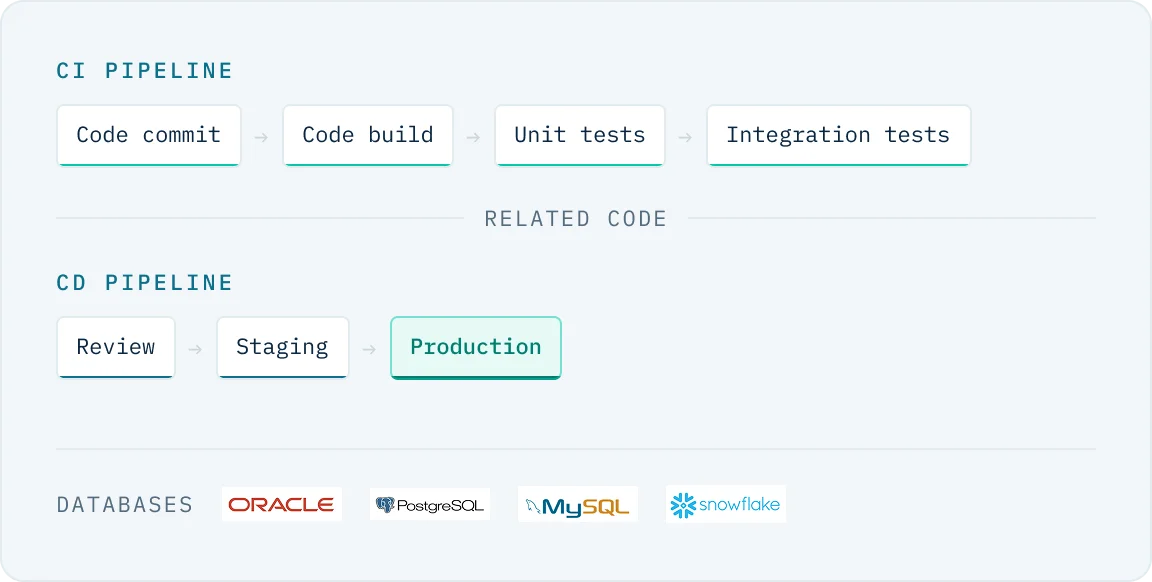
Secure and Govern the Database Release Pipeline.
Every database change is a potential path to sensitive data. Enterprises need to control who can change what, where and when, and prove it to auditors. Controls to require: SSO and MFA, role-based access tied to Active Directory or LDAP, encrypted credentials or vault integration, segregated dev and production networks, and a full audit trail of every change.
Is Your Database Release Pipeline a Security Gap?
Free and ad-hoc database CI/CD tools often lack enterprise-grade access control and auditing. This article lists the security layers a database release process needs and how to put them in place.
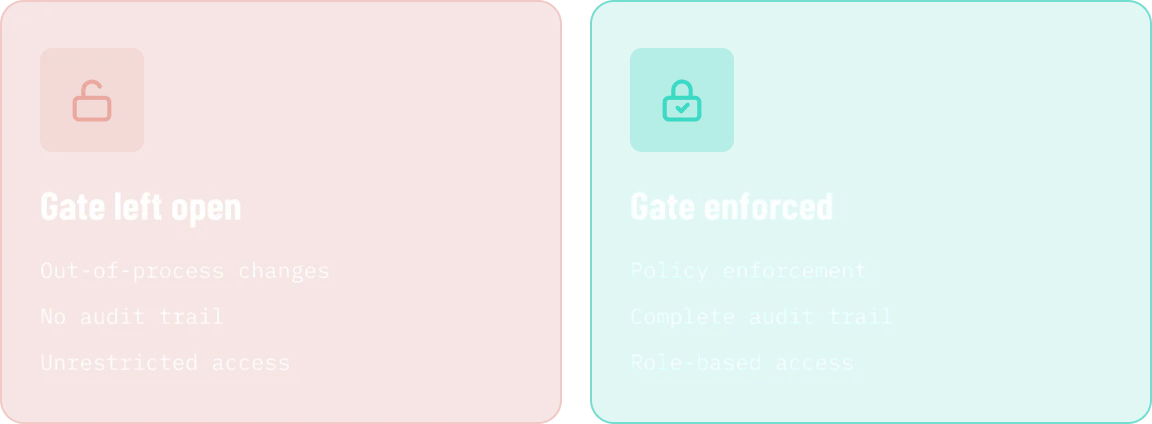
Measure Database DevOps with DORA Metrics.
DORA's four metrics (deployment frequency, lead time for changes, change failure rate and time to restore service) are the standard for DevOps performance. Most organizations track them only for application code, which hides the database as the bottleneck. Applying them to database releases shows leadership where time and risk sit, and proves improvement over time.
Using DORA Metrics to Measure Database DevOps Success
DevOps success in software development hinges on streamlining processes and optimizing delivery pipelines. While DevOps has revolutionized application development, database management often remains a bottleneck, hindering overall efficiency. This is where DBmaestro emerges as a game-changer, meticulously forging the DORA metrics to ensure seamless database DevOps integration.

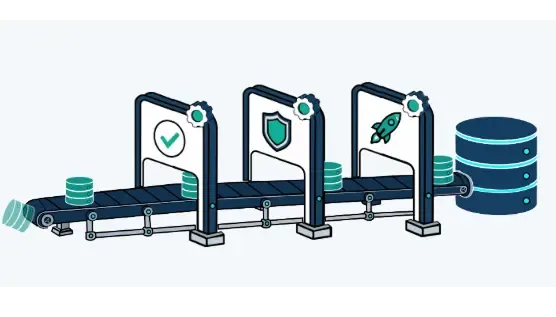
Automate Database Releases End to End.
With changes versioned, secured and measured, the last step is end-to-end release automation: packaging, validating, dry-running and promoting database changes through the same pipeline as the application, with drift detection and approvals built in.
A well-structured and automated database change management pipeline can significantly reduce errors, improve collaboration, and enhance the overall efficiency of your development team. In this article, we will explore the key strategies and tools for automating database changes within your pipelines.
The impact teams see with DBmaestro
- DBA Team Productivity
-
 65%
65%
- Database Change Delivery Time
-
 97%
97%
- Documented Changes
-
100%
- Compliance Automation
-
100%
- Delivery Capacity
-
250×
- Downtime Reduction
-
15%
Running Database Releases at App Speed - Pilot Flying J Success Story
Where Is Your Organization on the Journey?
| Step | Symptom if missing | Business outcome | DBMaestro capability |
|---|---|---|---|
| 1. Cut release costs with automation | Database releases wait days for manual DBA scripting and review | Lower cost per release; DBAs freed for higher-value work | Database Release Automation |
| 2. Version control for database changes | No single record of who changed what; environments drift apart | One source of truth, full change history, fast rollback | Database Source Control |
| 3. Secure and govern the pipeline | Shared credentials, broad production access, audit evidence gathered by hand | Controlled access, enforced policies, audit-ready trail | Database Security & Compliance |
| 4. Measure with DORA metrics | Delivery performance tracked for app code only; the database is a blind spot | Visible bottlenecks and proven improvement for leadership | Database DevOps Observability / DORA-driven DevOps Success |
| 5. Automate releases end to end | Database changes deployed outside the CI/CD pipeline, out of sync with the app | App and database released together, faster and more predictably | Database Release Automation + CI/CD integrations |
Upgrade your Database DevOps to Full Automation

FAQ
-
What is database DevOps?
Database DevOps applies DevOps practices (version control, CI/CD, automated testing, and monitoring) to database schema and code changes. It lets database changes move through the same pipeline as application code, so releases are faster, repeatable and auditable instead of relying on manual scripts and DBA handoffs.
-
What are the five steps of the Database DevOps Value Journey?
1. Cut release costs with automation, 2. put database changes under version control, 3. secure and govern the release pipeline, 4. measure performance with DORA metrics, and 5. automate database releases end to end. Each step builds on the one before.
-
Why are databases often left out of CI/CD pipelines?
Databases hold state, so a bad change cannot simply be redeployed over. Teams worry about data loss, drift between environments and compliance, so database changes stay manual. Database version control and release automation with dry-runs and rollback remove that risk.
-
How do DORA metrics apply to database releases?
The same four metrics apply: how often database changes reach production, how long a change takes from commit to production, what share of database releases fail, and how fast service is restored. Tracking them for the database shows whether it is the bottleneck in overall delivery.
-
How does database DevOps support security and compliance?
It enforces who can change which database, in which environment, and records every change. Typical controls include role-based access, SSO and MFA, approval gates, policy checks before deployment and a full audit trail that supports standards such as SOX, HIPAA and GDPR.
-
Which databases does DBmaestro support?
DBmaestro supports multi-database environments, including Oracle, SQL Server, PostgreSQL, MySQL, DB2 and cloud databases, from one platform, and integrates with CI/CD tools such as Jenkins, Azure DevOps, GitLab and IBM DevOps.
-
How long does it take to start automating database releases?
Most teams start with one application and one database pipeline, then expand.