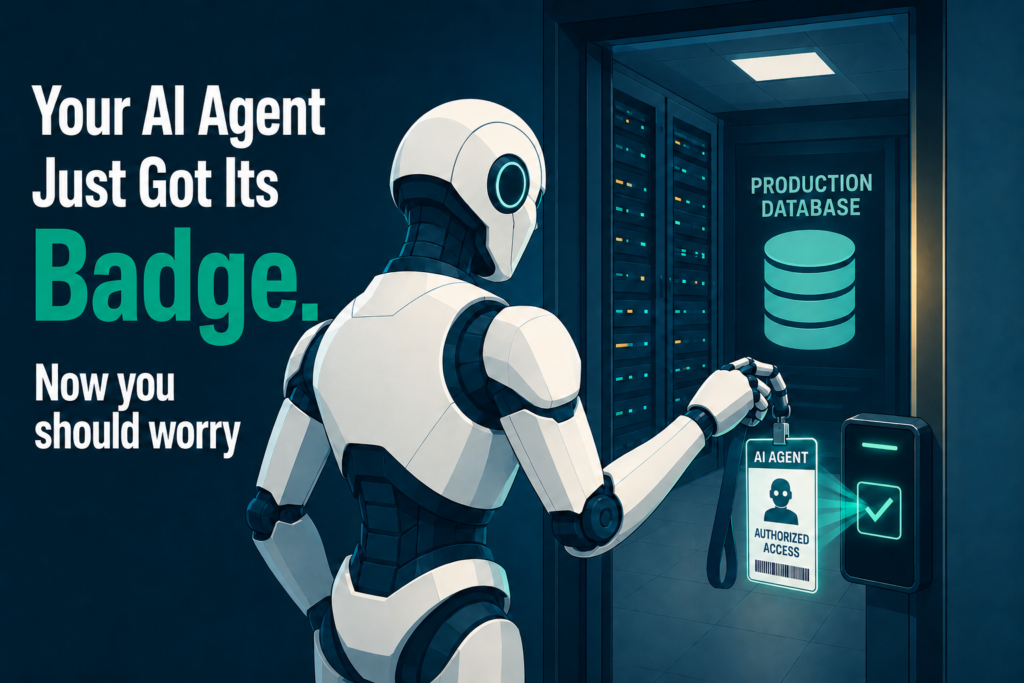



The automation worked perfectly, right up to the moment the database was involved.
Pipelines were running, AI agents were generating code, triggering deployments, even resolving incidents. Dashboards were green, velocity was up, leadership was impressed. It felt like the future had finally arrived.
Until the database was touched - That’s when the illusion broke.
Because while AI is accelerating everything around the system, the database remains what it has always been - a system of record, governed by structure, order, and state. And when those two worlds collide without control, the result is fragility instead of innovation. Not the obvious kind, of security breaches or dramatic failures, but a quieter kind of fragility. Structural. Accumulative. The kind that only shows itself when it’s already too late.
Here are five places where it begins:
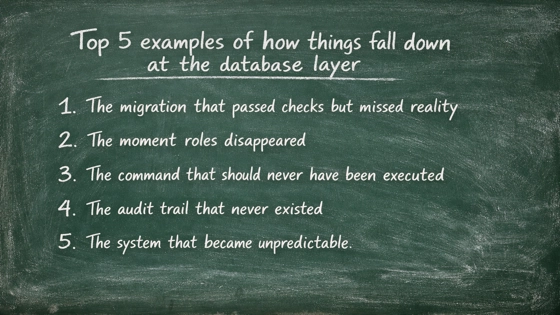
1. The migration that passed checks but missed reality
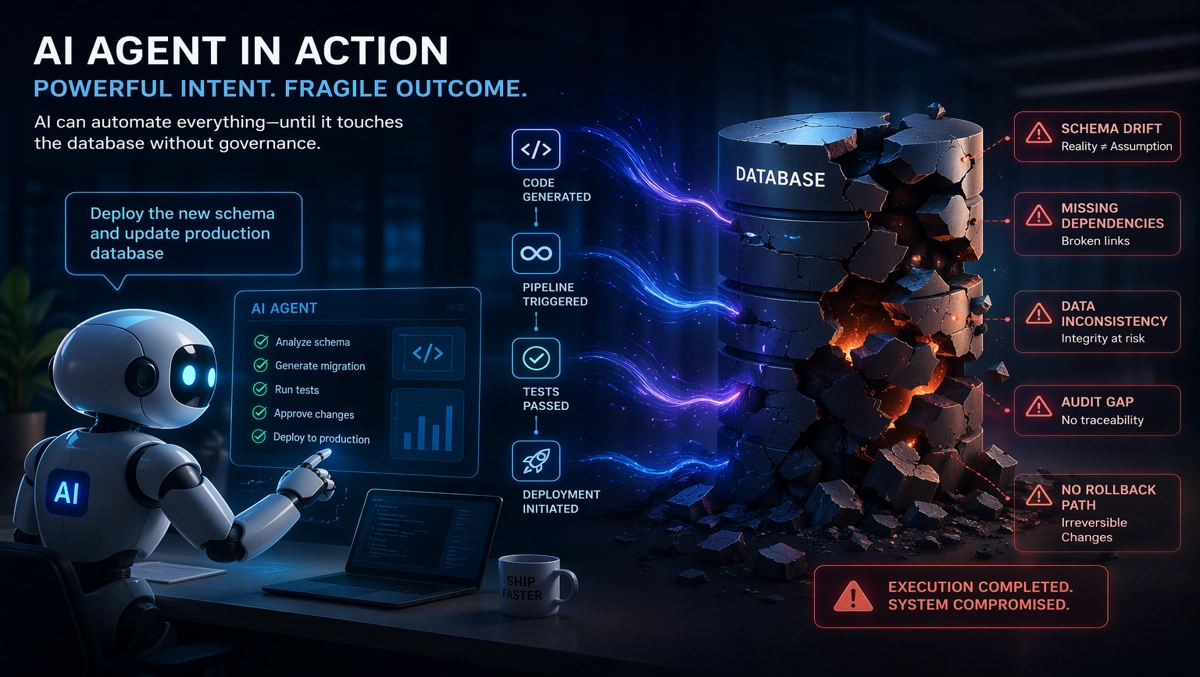
An AI agent generates a migration that looks perfect: syntactically correct, clean, logical. It gets approved, merged, and deployed through an automated pipeline. But the agent is working from context, not ground truth. It inferred the schema from code, earlier prompts, or partial visibility, while the real production database had already changed through hotfixes, drift, and undocumented dependencies. So the migration renames a column a live service still needs, overwrites a view that was altered, or pushes a change that fits one environment but breaks another. The pipeline sees valid code and passing tests. What it never checks is whether the database actually matches the model the AI was acting on. Nothing fails loudly at first. The system just drifts further from reality, until downstream processes break or data is corrupted in ways no test environment ever exposed.
2. The moment roles disappeared
There was a time when a developer wrote the change, a DBA reviewed it, and a release manager controlled when it went live. It wasn’t always efficient, but it worked, and most importantly, it was a controlled process part of a larger controlled system.
AI collapses all of that.
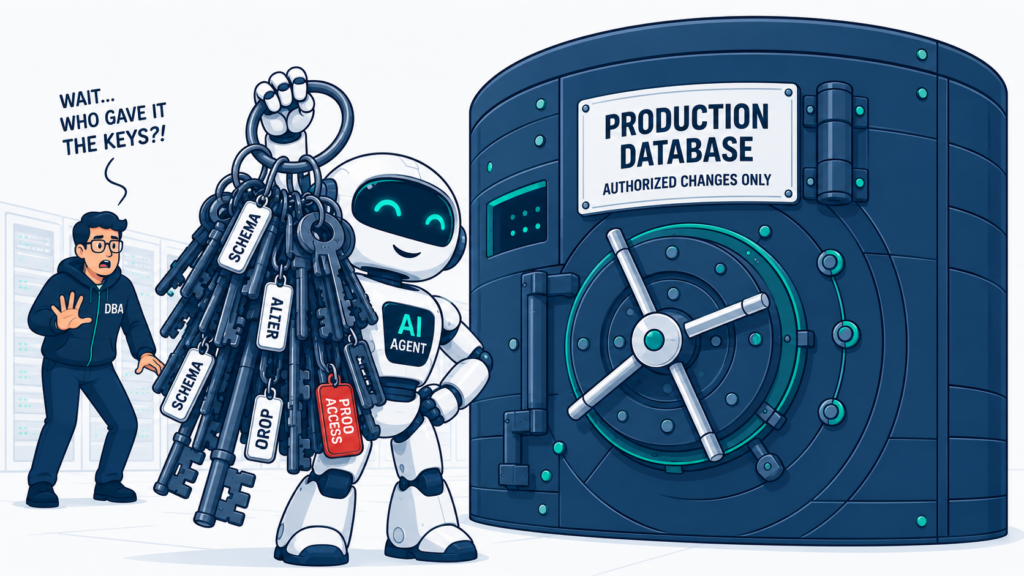
One prompt can now generate, approve, and execute a database change in a single flow. No pause. No separation of duties. No independent validation. From a productivity standpoint, granted, it’s very impressive. But from a governance standpoint, it’s a breakdown, one which most organizations don’t even realize about until audit time.
3. The command that should never have been executed
Fact: Humans hesitate. Even experienced engineers pause before running a destructive command. They check dependencies. They think about impact. They ask one more question, and sometimes that one more question is the critical element that avoids disaster.
AI does not hesitate, it executes what it was asked to do: Drop a table. Modify a constraint. Change an index tied to a huge dataset without understanding that it will lock systems and run for hours. Or push a change that works technically, but violates company policy, approval rules, or data governance standards.
As far as the AI Is concerned, the command is valid, the syntax is correct. It doesn't care that the outcome is catastrophic. And the system records it as a successful deployment.
4. The audit trail that never existed
When something goes wrong, organizations ask simple questions:
What changed?
Who approved it?
Why was it allowed?
In traditional systems, the answers are already difficult to recreate. In AI-driven execution, they become almost impossible. Even if you have the prompt and the pipeline log, you often don’t have a clear, structured record of what actually changed inside the database, what policies were evaluated, and why the system allowed it to happen.
In regulated environments, that’s more than just a major gap, that’s significant exposure.
5. The system that became unpredictable
This is the most dangerous one because it doesn’t show up immediately.
AI accelerates change. Result? More deployments, faster cycles, less friction.
But without governance at the database layer, every change increases the chance of drift, inconsistency, and hidden dependency conflicts. Over time, the system becomes harder to reason about. Not only is the system increasingly and incredibly complex, it's now also become something that is no longer deterministic.
When teams start relying even more on AI to navigate the uncertainty, which only accelerates the problem.
This is the governance gap no one talks about.
The industry is focused on how AI can generate more, deploy faster, automate everything. And it can. That part is real, no one is doubting that, but execution is no longer just about speed.
It’s about control.
AI has become the interface to execution, but the database is still the place where consequences live. Without a layer that enforces policy, understands real state, validates dependencies, and preserves auditability, AI doesn’t just introduce risk, it introduces fragility into the core of the system.
Not because AI fails often, but because when it does fail, it fails hard, and the system has no way to contain it.
The answer is not to slow AI down. It’s to redefine how it executes.
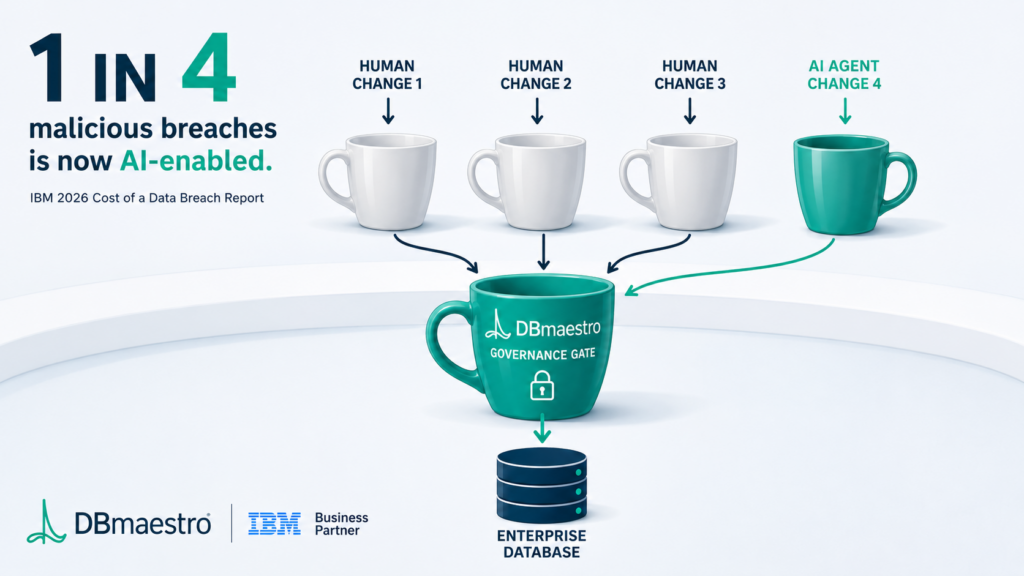
AI should not act directly on the database. It should operate through governed and secure execution gateways - which is exactly where the DBmaestro MCP server comes into play:
DBmaestro's MCP serves as the authoritative gateway between AI agents and the enterprise database, ensuring that every action is mediated, controlled, and executed within defined boundaries before it reaches the system of record. Whether it's routing requests or governing execution, with DBmaestro, every AI-initiated action is evaluated against real database state, validated against organizational policies, and aligned with dependencies and environmental context before it is allowed to proceed.
DBmaestro's MCP Server:
- Distinguishes between what was requested and what is actually safe to execute.
- Enforces separation of duties, even when the request originates from an autonomous agent.
- Ensures that every change is validated prior to execution, fully auditable after the fact, and reversible if required.
DBmaestro's MCP Server is the shift from automation to controlled execution, the difference between controlled acceleration and chaotic instability
In the end, the database doesn’t care how advanced your AI is. It only cares whether the change was correct, and if it wasn’t, no amount of upstream intelligence will save you.