|
|
- Blog |
- Manual Database Management: A Tightrope


Database DevOps
Manual Database Management: A Tightrope
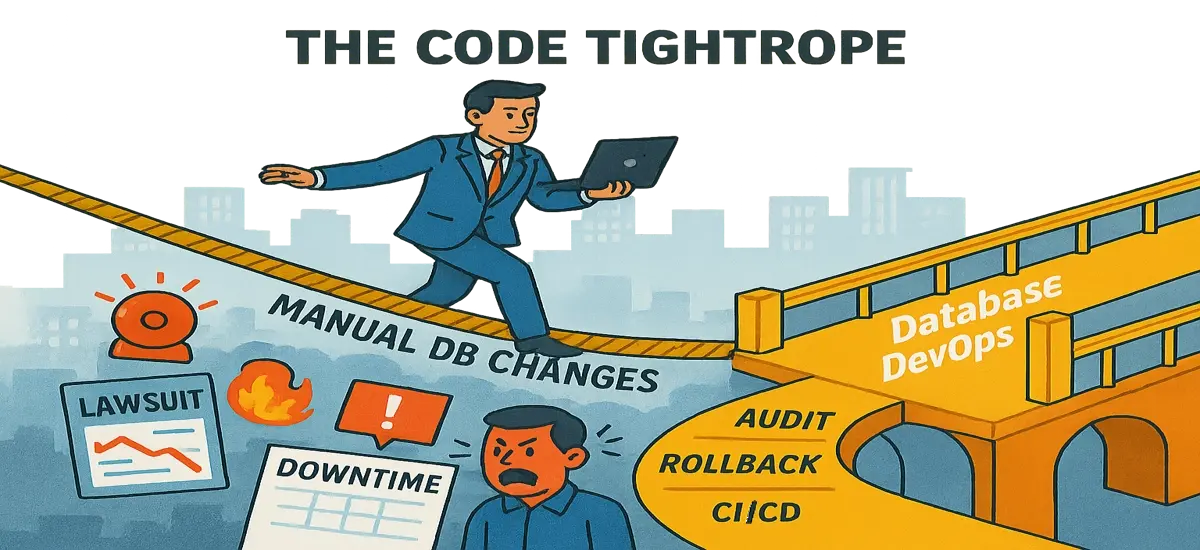
Businesses today walk a tightrope when it comes to managing their databases. Applications evolve quickly, user expectations are higher than ever, and regulators demand compliance without compromise. Yet, many organizations still rely on manual database management to handle schema changes, stored procedures, and deployments.
On the surface, this might seem manageable, but the reality is stark: manual database DevOps is dangerous, risky, and expensive. One wrong step can send a business tumbling into downtime, noncompliance, and customer dissatisfaction.
This article explores the dangers of manual database management and explains how DBmaestro, the leading Database DevSecOps platform, helps organizations move off the tightrope and onto solid ground.
The Dangers of Manual Database DevOps

-
Human Error – The Constant Threat
Every manual step in a release pipeline is an invitation for mistakes. A missed dependency, a typo in a script, or an overlooked rollback plan can cause catastrophic outages. Unlike application code, which is designed to fail safely in test environments, database changes often execute directly against production data. Errors here can’t simply be undone – they ripple into corrupted data, customer impact, and long downtime.
-
Environment Drift – When Test and Prod Don’t Match
In a manual process, it’s rare for database changes to move through Dev, Test, Staging, and Production in perfect sync. What works in one environment fails in another, creating endless troubleshooting loops. Environment drift slows down releases and erodes confidence in the release pipeline.
-
Lack of Governance and Auditability
Regulatory frameworks such as SOX, HIPAA, PCI-DSS, and GDPR all demand clear answers to three questions: who made this change, when, and why? Manual processes struggle to deliver these answers. Scripts circulate by email, DBAs log into production directly, and version history disappears. When auditors arrive, organizations find themselves scrambling.
-
Bottlenecks in Release Cycles
Agile teams can push application code multiple times a day through automated pipelines. Yet when they reach the database layer, everything slows down. Changes wait in DBA queues, releases get rescheduled, and entire sprints lose momentum. This is why databases are often the bottleneck in CI/CD pipelines.
-
Security and Identity Risks
Manual processes often rely on shared credentials or direct database access. This opens the door to insider threats, misused privileges, and even identity theft. When dozens of developers, DBAs, and contractors all share the same credentials, there is no way to know who actually made a change or whether it was authorized.
-
Hidden Costs and DBA Toil
Skilled DBAs spend countless hours on repetitive tasks like running scripts, fixing failed deployments, and reconciling environments. These tasks add little business value but consume critical resources. Over time, the result is higher costs, increased burnout, and difficulty scaling database operations.
DBmaestro: Turning the Tightrope into a Bridge
Walking a tightrope is thrilling for a circus act – but for enterprises, it is unsustainable. DBmaestro replaces manual risk with automated control, enabling organizations to treat database changes with the same rigor and speed as application code. Let’s see how DBmaestro addresses each of the major challenges.
-
Preventing Human Error
DBmaestro introduces automation and guardrails into every database release.
- Automated Validations: Scripts are checked for conflicts, dependencies, and potential impact before they ever touch production.
- Safe Rollbacks: If something does go wrong, DBmaestro provides controlled rollback options, ensuring downtime is minimized.
- Error Prevention: Built-in policies catch risky changes, such as dropping a critical table or deploying untested code, before they cause damage.
Result: Reduced downtime, fewer outages, and far less firefighting for DBAs.
-
Eliminating Environment Drift
DBmaestro enforces consistency across environments.
- Version Control for Database Code: Schema changes, stored procedures, and reference data are stored in Git repositories.
- Automated Synchronization: Changes flow seamlessly from Dev to Test to Prod.
- Deployment Pipelines: The same tested change is applied across all environments, eliminating drift.
Result: If it worked in Test, it works in Production – confidence is restored.
-
Governance and Compliance Built In
DBmaestro provides the governance layer that manual processes lack.
- Full Audit Trails: Every change is logged, linked to a user, and mapped to a ticket or business justification.
- Compliance Reporting: Dashboards and reports make regulatory audits straightforward.
- Policy Enforcement: Changes that don’t meet corporate standards or compliance requirements simply don’t get deployed.
Result: Compliance becomes proactive rather than reactive, reducing the risk of fines or regulatory breaches.
-
Accelerating Release Cycles
DBmaestro integrates database changes into the same CI/CD pipelines used for applications.
- Pipeline Integration: Works seamlessly with Jenkins, GitLab, Azure DevOps, and other CI/CD tools.
- Parallel Releases: Application and database changes move together, eliminating the bottleneck.
- Metrics and Insights: Delivery performance is tracked with DORA metrics for both application and database layers.
Result: Releases accelerate, keeping pace with business demands and customer expectations.
-
Securing Access and Identity
DBmaestro enforces strict control over who can change what, and where.
- Role-Based Access Control (RBAC): Ensures that only authorized users can execute changes.
- Integrating Secrets Management vaults: Eliminates the need for shared credentials by integrating with vault solutions.
- Identity Attribution: Every action is linked to an individual user, closing the door on anonymous changes.
Result: Database security strengthens, insider threats shrink, and compliance with identity requirements is guaranteed.
-
Reducing Toil and Hidden Costs
By automating repetitive tasks, DBmaestro frees DBAs to focus on strategic work.
- Automated Deployments: No more manual execution of scripts.
- Self-Service for Developers: Teams can deploy database changes safely without waiting on DBA intervention.
- Shift to Value: DBAs spend more time optimizing performance, scaling systems, and guiding strategy.
Result: Lower operating costs, reduced burnout, and greater scalability of database operations.
Why Manual is No Longer an Option
In the past, organizations tolerated manual database management because there was no alternative. Today, with the rise of DevOps, cloud, and regulatory scrutiny, that tolerance is gone. Manual database DevOps is not only slow – it is a liability. Enterprises that fail to automate are left exposed on every front: operational stability, compliance, security, and cost.
DBmaestro is designed to remove this exposure. By automating database release management, enforcing governance, and integrating seamlessly with existing DevOps pipelines, it transforms the tight rope into a wide, secure bridge that carries organizations toward agility and resilience.
Conclusion: From Balancing Act to Competitive Advantage
Manual database management forces organizations into a dangerous balancing act – a tightrope where every step could lead to a fall. Human error, inconsistent environments, compliance failures, bottlenecks, and security risks all conspire to keep enterprises unstable.
DBmaestro provides the balance pole, safety net, and bridge all in one. It brings the principles of DevOps – automation, governance, speed, and security – to the last frontier of software delivery: the database.
Organizations that adopt DBmaestro move off the tightrope and onto solid ground. They release faster, stay compliant, reduce risk, and empower their teams to focus on innovation rather than firefighting. In today’s world, that isn’t just safer – it’s a competitive advantage.
Get your demo now
Related Articles