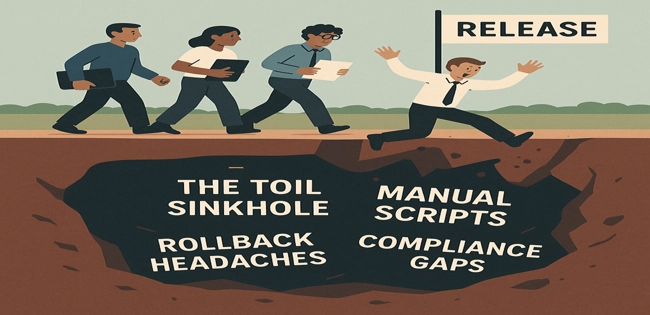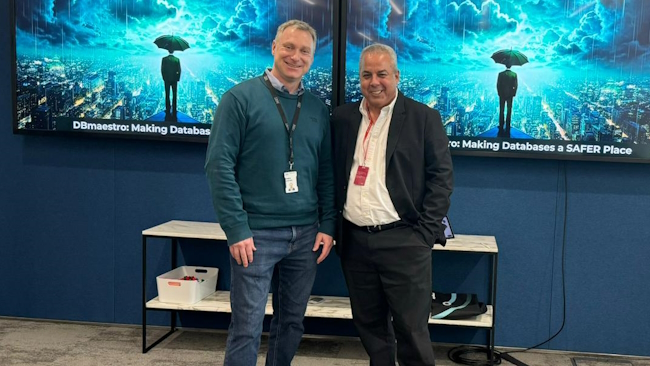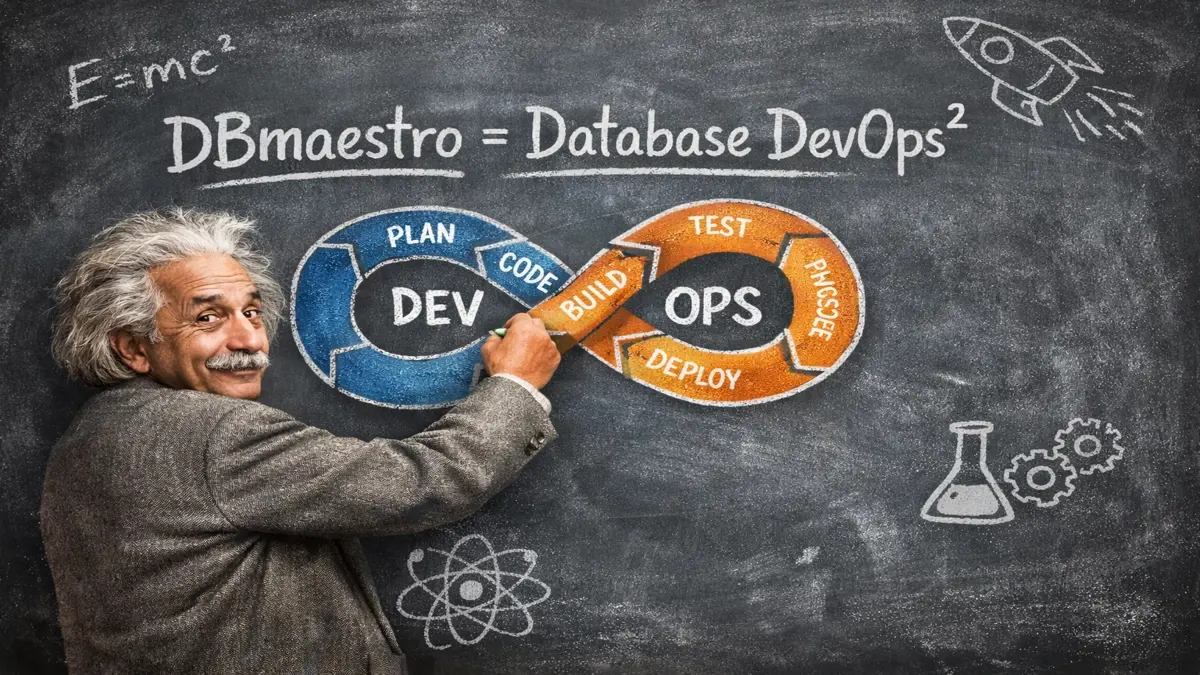
DBmaestro Is Scientifically Proven

That may sound like an unusual statement for a Database DevOps platform.

But after years working with large enterprises, I started noticing something interesting:

The problems we see in database change management look surprisingly similar to problems scientists have studied for centuries.

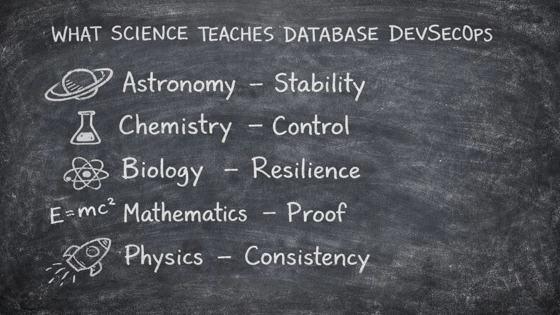
Astronomy, Chemistry, Biology, Mathematics and Physics.

Each of these disciplines explains something fundamental about how complex systems survive constant change.

And the same principles appear again and again in Database DevSecOps.

When people talk about DevOps, they usually talk about speed.

When people talk about databases, they usually talk about risk.

But when you step back and look at how complex systems really work – in nature, in mathematics, in physics – something interesting becomes clear. The most stable systems are not the ones that avoid motion. They are the ones that manage motion intelligently.

That is exactly why I have been exploring Database DevSecOps through the lens of science.

Not because enterprise software needs more academic language. Quite the opposite. The value here is that science gives us simple, intuitive ways to understand what makes systems stable, resilient, and trustworthy under constant change.

Across five short pieces inspired by astronomy, chemistry, biology, mathematics, and physics, one idea keeps repeating itself:

Stable systems are not static systems. They are governed systems.

And that is exactly where DBmaestro comes in.
Stability Is Not About Standing Still

In astronomy, planets remain stable not because nothing moves, but because everything moves within forces that are known, balanced, and consistent.

Gravity does not stop motion. It regulates it.

Without gravity, there is no orbit. There is chaos.

Read more:
https://www.dbmaestro.com/blog/database-devops/held-in-orbit-what-gravity-teaches-us-about-stability-in-database-devsecops/

Enterprise software is no different. Application teams are in constant motion. New releases, patches, schema changes, hotfixes, testing cycles, production pushes – all of it is moving all the time.

The problem is that in many organizations, the database layer still operates outside the same governing forces that manage the application pipeline.

That is where things begin to drift.

Schema drift. Environment inconsistencies. Failed releases. Audit gaps. Production instability.

DBmaestro brings the database back into orbit. It applies control to movement, not by slowing the business down, but by making change traceable, governed, and synchronized with the rest of the software delivery process.

That is not just automation. That is engineered stability.

Change Is Not the Enemy – Uncontrolled Change Is

In chemistry, chain reactions are not inherently dangerous. In fact, controlled reactions power much of the modern world.

What makes the difference is whether the reaction is governed.

Read more:
https://www.dbmaestro.com/blog/database-devops/catalyzed-change-what-chain-reactions-teach-us-about-database-devsecops/

That same logic applies to enterprise delivery pipelines.

A software release is really a chain reaction. A developer makes a change. Code moves into build. Testing kicks off. Dependencies activate. Artifacts are promoted. Environments are updated. Production is released.

When database changes are handled manually or separately, the chain reaction becomes unstable. The application moves at DevOps speed, while the database waits for scripts, approvals in email, or tribal knowledge.

That is where friction appears.

DBmaestro helps turn database change into a controlled reaction. Changes are versioned, validated, policy-checked, and deployed in a governed sequence.

The takeaway is simple: change itself is not the problem. The real risk is unmanaged change.

And that is a message every technology leader understands instinctively.

Resilience Is a Living Capability

In biology, the immune system does not create safety by preventing all exposure. It creates safety by constantly monitoring, identifying anomalies, and responding quickly when something goes wrong.

That is what resilience really looks like.

Not perfection. Not stillness. Not isolation.

Response capability.

Read more:
https://www.dbmaestro.com/blog/database-devops/continuous-resilience-in-database-devsecops-what-the-immune-system-teaches-us-about-surviving-constant-change/

Modern enterprises need the same posture at the database layer. No matter how disciplined the organization is, changes will keep happening. Teams will move fast. Priorities will shift. Environments will evolve. Risk will never disappear completely.

The question is whether the organization has the capability to detect issues early, understand what changed, and recover with confidence.

DBmaestro brings that resilience into the database delivery lifecycle. It helps organizations monitor and control database changes continuously rather than treating each release like an isolated event.

That matters because resilience is no longer optional. In a world of constant delivery, resilience is the operating model.

Trust Depends on Proof

In mathematics, trust does not come from confidence or opinion. It comes from proof.

A proof shows how an outcome was reached, step by step, in a way that others can verify.

Read more:
https://www.dbmaestro.com/blog/database-compliance-automation/in-proof-we-trust-what-mathematics-teaches-us-about-determinism-in-database-devsecops/

That same requirement increasingly exists in enterprise technology, especially in regulated environments.

It is no longer enough to say, “We have a process.”

Organizations need to show evidence of who changed what, when it changed, what approvals were given, and how the change progressed across environments.

This is where manual database processes become a real liability. Scripts are changed informally. Records are incomplete. Approvals are scattered. Evidence is hard to reconstruct.

DBmaestro changes that equation by making database change management deterministic and auditable. It creates a structured, repeatable, evidence-based process for one of the most sensitive parts of enterprise IT.

That is powerful not only for compliance teams, but for engineering leadership as well.

Because when a process is provable, it becomes scalable.

Complex Systems Need Rules

In physics, complex systems become understandable when they operate under known laws.

Without rules, there is randomness. With rules, there is predictability.

Read more:
https://www.dbmaestro.com/blog/database-compliance-automation/what-physics-can-teach-us-about-enterprise-change/

This is exactly what many enterprises are still missing in the database domain.

Application pipelines may already be standardized and automated. But when database changes are executed manually, outside policy enforcement and without deployment discipline, the organization ends up with two different operating models:

One modern model
One legacy model

That split is costly.

It creates bottlenecks, slows release cycles, increases risk, and undermines the reliability of the entire software delivery chain.

DBmaestro helps unify the rules of change across the enterprise. It introduces consistency, policy, orchestration, traceability, and control into the database lifecycle so that the entire delivery system behaves more predictably.

And predictability is what turns isolated success into scalable execution.

So What Does “Scientifically Proven” Really Mean?

To be clear, this is not about dressing up software with scientific metaphors.

It is about recognizing that the principles behind stable, resilient, and trustworthy systems are already well understood.

Astronomy teaches us that stability requires governing forces.
Chemistry teaches us that reactions need control.
Biology teaches us that resilience comes from detection and response.
Mathematics teaches us that trust requires proof.
Physics teaches us that complexity must operate within rules.

DBmaestro applies those exact principles to the world of database change.

That is why the platform resonates so strongly with organizations trying to modernize delivery without compromising control.

It is not only about deploying faster.

It is about building a system where speed, safety, compliance, and predictability can actually coexist.

The Bigger Point

For years, the database has been treated as the exception inside DevOps.

Applications could move fast. Infrastructure could be automated. Pipelines could be orchestrated. But the database often remained the fragile, manually managed part of the estate.

That model no longer works.

The enterprise cannot become truly agile while the data layer remains outside governance.

DBmaestro solves that problem in a way that is practical, disciplined, and increasingly essential.

Not by adding noise.
Not by adding theory.
But by bringing proven system logic into the place where enterprises need it most.

That is why DBmaestro is not just a tool for database automation.

It is a platform built on principles that have governed stable systems for centuries.

And in that sense, yes –

DBmaestro is scientifically proven.

Held in Orbit: What Gravity Teaches Us About Stability in Database DevSecOps

In space, everything is moving.

Planets travel at extraordinary speeds. Moons rotate. Entire solar systems drift through galaxies. Nothing stands still.

And yet, despite this constant motion, systems remain stable.

Earth does not fly off into darkness. The moon does not spiral unpredictably. Planets do not collide randomly.

The reason is not the absence of motion.

The reason is gravity.

Gravity creates orbit. Orbit creates order. Order allows motion to continue safely.

Without gravity, motion becomes drift. With gravity, motion becomes structure.

Modern enterprises operate inside the same dynamic.

Change is constant. Releases are continuous. Teams are distributed. Regulations evolve. Data expands. Systems integrate across platforms and regions.

Everything is moving.

The question is whether it is held in orbit.

Drift Is Quiet

In astronomy, when gravitational pull weakens, objects drift.

They do not explode immediately. They move slightly off course. Slowly. Quietly. Almost invisibly.

In large organizations, database drift behaves the same way.

A schema change bypasses the formal path.
A permission adjustment is granted temporarily and forgotten.
An environment deviates slightly from its baseline configuration.

None of it feels catastrophic at first.

But without structural governance, these small deviations accumulate. Systems that once moved in harmony begin to separate. Alignment weakens. Visibility fades.

Teams compensate.

Developers grow cautious about touching database structures.
DBAs tighten approvals to protect production.
Security increases manual review.
Compliance reacts after issues surface.

The system continues moving, but it is no longer aligned.

Drift is not dramatic.

It is structural decay.

Motion Requires a Center

Every orbit depends on mass. The larger the central body, the stronger the gravitational field. The stronger the field, the more stable the system.

In enterprise architecture, the database is the mass.

It is the system of record. Financial truth. Customer data. Regulatory reporting. Business logic. Everything of consequence accumulates there.

Applications orbit it. Services depend on it. Analytics derive from it.

Yet in many organizations, governance around the database layer is weaker than governance around application code.

CI pipelines are structured. Infrastructure is automated. But database change still relies on manual coordination and human enforcement.

That is equivalent to placing planets in motion without sufficient gravitational pull.

Eventually, something drifts.

The Cost of Weak Gravity

When systems are not held in orbit, instability rarely looks dramatic at first.

It shows up as friction.

Release cycles slow.
Cross-team trust weakens.
Audit reviews become tense.
Security exceptions increase.

Energy is spent correcting trajectory instead of building value.

In space, instability leads to collision or escape velocity.

In enterprises, instability leads to outages, audit findings, and organizational fatigue.

The answer is not to reduce motion.

The answer is to strengthen gravity.

DBmaestro as Gravitational Force

DBmaestro provides that structural gravity at the database layer.

It does not slow teams down. It does not eliminate motion. It creates the governing force that keeps everything aligned.

Every database change becomes versioned and traceable. Promotion paths are controlled. Separation of duties is enforced automatically. Drift is detected before it spreads. Rollback is engineered into the lifecycle.

These are not isolated features.

They are gravitational properties.

They ensure that applications, environments, and teams remain aligned with the system of record.

Without gravity, motion turns into fragmentation.

With gravity, motion becomes sustainable.

Collaboration in Orbit

Gravity does more than prevent drift. It coordinates movement.

Planets move independently, yet their paths are predictable because they share a common center.

In DevSecOps, developers, DBAs, security leaders, and compliance teams operate autonomously. Without structural governance, autonomy becomes fragmentation.

With embedded governance, autonomy becomes coordinated orbit.

Developers move quickly because policies validate changes automatically.
DBAs trust the process because enforcement is systemic.
Security sees violations blocked before escalation.
Compliance receives continuous evidence instead of retrospective reconstruction.

The organization does not centralize power.

It centralizes gravity.

The Takeaway

Gravity is invisible.

You do not see it directly. You see its effect.

Planets remain in orbit. Systems remain stable. Motion continues without collapse.

Customers describe this same shift in practical terms.

One enterprise team shared that before implementing DBmaestro, database deployments were manual and error-prone. After implementation, they were able to establish a successful database DevOps practice and deliver consistently accurate database schemas and code .

A large financial institution explained that integrating DBmaestro into their Azure DevOps pipeline enabled more frequent and reliable deployments. Manual intervention was eliminated, and failures now trigger immediate feedback loops back to development, accelerating troubleshooting and stabilizing releases .

That is gravity in action.

The system does not slow down. It becomes structurally aligned.

What you can expect from DBmaestro is not simply automation.

You can expect alignment at scale.

You can expect database change to remain in orbit even as velocity increases.

In astronomy, gravity determines whether motion becomes chaos or stability.

In enterprise Database DevSecOps, engineered governance determines the same.

And when that gravitational force is strong enough, scale stops being a risk and becomes an advantage.

Catalyzed Change: What Chain Reactions Teach Us About Database DevSecOps

In chemistry, the most dangerous reactions are not the large ones.

They are the uncontrolled ones.

A chain reaction rarely begins with an explosion. It starts quietly. A bond shifts. Energy is released. That energy destabilizes something nearby. Another bond changes. Then another. If nothing contains it, the reaction accelerates on its own.

Placed inside a controlled chamber, guided by the right catalyst, the same reaction becomes transformation.

Modern development teams operate inside constant reaction cycles.

A feature request leads to code.
Code requires a schema adjustment.
Schema changes affect reporting.
Reporting impacts analytics.
Analytics influences decisions.

One action rarely stays isolated.

Most organizations believe their challenge is speed. In reality, their challenge is reaction control.

The Quiet Start of Instability

Database incidents rarely begin dramatically.

They begin with something small. A table modification late in a sprint. A temporary permission granted for convenience. A hotfix applied directly in production to meet a deadline.

Individually, none of these actions feel catastrophic.

But chemistry teaches us that instability does not announce itself early. It escalates when reactions spread unchecked.

In software delivery, that spread looks like drift between environments, inconsistent deployments, hidden privilege expansion, and growing mistrust between teams.

Developers hesitate to touch the database.
DBAs tighten controls defensively.
Security adds manual review layers.
Compliance steps in after the fact.

Velocity slows not because talent is missing, but because confidence erodes.

The system becomes volatile.

Friction Is Not Stability

When reactions feel unstable, organizations often add friction.

More approvals. More documentation. More checkpoints between intent and execution.

This raises activation energy. Change becomes harder to initiate.

For a while, it feels safer.

But pressure builds. Releases grow larger. Risk concentrates. When change finally happens, it happens in heavier, more fragile batches.

Chemistry offers a different answer.

Instead of friction, introduce a catalyst.

A catalyst allows transformation to occur more predictably. It lowers the energy required for change while preventing destructive side reactions.

This is precisely what Database DevSecOps must achieve at the database layer.

The Database as Reaction Amplifier

Application changes can often be isolated. Infrastructure can be reprovisioned. Containers can be redeployed.

The database is different.

It holds financial records, customer data, regulatory reporting structures, and operational logic. A small schema shift can ripple across services. A permission adjustment can affect multiple business units. Environment drift can surface months later during audit review.

The database amplifies reactions.

When teams sense that amplification, they grow cautious. Caution reduces collaboration. Reduced collaboration increases informal workarounds. Workarounds introduce side reactions.

The chemistry between teams destabilizes.

The issue is not change.

The issue is uncontrolled change.

Collaboration as Chemical Stability

Reactions depend on how elements interact.

In organizations, developers, DBAs, DevOps engineers, security leaders, and compliance teams are reactive elements. If their interaction relies solely on manual coordination and personal trust, complexity eventually destabilizes them.

When governance is embedded in the system, collaboration changes.

Developers know their changes will be validated automatically.
DBAs trust that policies are enforced consistently.
Security sees violations blocked before escalation.
Compliance receives continuous evidence instead of post-incident reconstruction.

The reaction chamber becomes structured.

Collaboration stabilizes because uncertainty is reduced.

DBmaestro as Catalyst

DBmaestro acts as both the reaction chamber and the catalyst for database change.

Every database modification becomes versioned and traceable. Separation of duties is enforced automatically. Drift is detected early. Rollbacks are engineered into the delivery lifecycle.

The governed path becomes the natural path.

By embedding policy enforcement directly into the CI/CD pipeline, DBmaestro lowers the energy required for compliant change. Developers do not negotiate every deployment manually. Security does not rely on retrospective audits. Compliance does not reconstruct history under pressure.

The reaction proceeds, but it remains controlled.

Transformation accelerates safely.

Preventing Side Reactions

In chemistry, side reactions waste energy and create unstable byproducts.

In enterprise delivery, side reactions appear as shadow scripts, emergency fixes, undocumented permission grants, and inconsistent environments.

They usually begin as attempts to bypass friction.

When the official path is complex, people create alternatives.

DBmaestro minimizes side reactions by making the governed path the easiest path. Violations are intercepted automatically. Policies are enforced consistently. Visibility is continuous.

Teams stop inventing unstable shortcuts.

The chemistry stabilizes.

What You Can Expect in Practice

This is not theory.

Enterprise customers describe the shift clearly.

One reviewer wrote on G2, “DBmaestro has delivered big for us and enabled us to launch a successful database DevOps practice. Prior to DBmaestro, all deployments were manual and error prone.” Another shared, “DBmaestro has solved our end-to-end CI/CD automation challenges. Integrating DBmaestro with Azure DevOps has taken our database code to market faster by streamlining the entire process with more frequent, reliable deployments.”

Those statements capture the chemistry.

Manual and risky becomes automated and traceable.
Drift becomes visible and eliminated.
Reactions become standardized rather than volatile.

What you can expect from DBmaestro is not the elimination of change.

You can expect controlled transformation.

You can expect visible governance.
You can expect collaboration without friction.
You can expect delivery that accelerates without destabilizing the system of record.

In chemistry, uncontrolled reactions destroy structures.

Controlled reactions build new ones.

Database DevSecOps depends on knowing the difference.

And the right catalyst makes all the difference.


Continuous Resilience in Database DevSecOps: What the Immune System Teaches Us About Surviving Constant Change

Most enterprises believe they are resilient.

They have documentation. Policies. Recovery plans. Control matrices. Audit binders. Everything looks structured and compliant.

But resilience does not live in documentation.

Resilience reveals itself under stress.

The best way to understand this difference is not through governance frameworks. It is through biology.

The human immune system does not exist to prevent exposure. It exists to survive exposure.

Viruses enter the body constantly. Stress is unavoidable. The environment is unpredictable. Yet the body does not freeze in fear. It detects. It isolates. It responds. It remembers.

It operates in a state of continuous resilience.

That is the standard modern enterprises must meet, especially at the database layer.

The Database as a Vital Organ

In any serious enterprise, the database is not just another system component. It is the system of record. Financial truth. Customer identity. Audit evidence. Regulatory reporting. Core business logic.

It is the digital equivalent of a vital organ.

And yet, while application and infrastructure automation have matured dramatically, the database layer in many organizations still operates with caution that borders on fragility.

Applications deploy frequently. Infrastructure scales elastically. But database change often remains semi-manual, heavily procedural, and dependent on institutional memory.

This creates structural risk.

Change does not slow down because the database team would prefer stability. Regulatory pressure does not decrease because delivery feels risky. Complexity does not pause while approvals circulate.

Stress accumulates.

In biology, a body that relied on manual intervention for every immune response would not survive. It requires detection, containment, automated reaction, and memory embedded directly into its architecture.

Database DevSecOps requires the same design principle.

From Readiness to Reality

There is growing recognition across industries that resilience on paper is not resilience in practice.

As articulated in a post by research group GRC 20/20 Research, resilience is not the absence of disruption. It is the ability to absorb shock, adapt under pressure, and continue delivering what matters most.

That distinction matters.

Readiness is preparation.

Resilience is behavior under stress.

In Database DevSecOps, resilience cannot mean well-documented processes. It must mean enforced governance. It cannot mean theoretical rollback. It must mean engineered rollback. It cannot mean assumed separation of duties. It must mean system-enforced separation of duties.

Continuous resilience is architectural.

Detection: Seeing Change Immediately

The immune system survives because it detects anomalies early. Recognition happens before damage becomes systemic.

In Database DevSecOps, detection means complete visibility into every database change. Schema updates. Privilege modifications. Configuration drift. Policy violations. Nothing should occur silently.

If change can happen without traceability, resilience is compromised.

A resilient database pipeline ties every modification to identity, intent, policy context, and outcome. Visibility is immediate. Governance is measurable.

You cannot contain what you cannot see.

Containment: Limiting Blast Radius

When the immune system detects a pathogen, it does not shut down the entire body. It isolates the issue. It limits spread. It keeps the response localized.

Database resilience requires the same discipline.

A development change must not silently propagate to production. A misconfiguration must not cascade across environments. Privilege escalation must not bypass governance controls.

Role-based access control, enforced separation of duties, controlled promotion paths, and engineered rollback mechanisms are not administrative preferences. They are containment mechanisms.

Without containment, even small mistakes become systemic events.

Resilience is measured by blast radius.

Automated Response: Systems Over Heroics

The immune system does not rely on meetings or escalation chains to respond to threats. It reacts automatically.

Database DevSecOps must behave similarly.

Manual enforcement does not scale with high release velocity. Human memory does not scale with regulatory scrutiny. Informal review processes do not scale across distributed engineering teams.

Continuous resilience requires embedded enforcement.

This is where DBmaestro becomes structurally important.

DBmaestro integrates governance directly into the database delivery lifecycle. Policies are enforced automatically before deployment. Separation of duties is validated by the system. Drift is detected continuously. Rollback capabilities are built into the architecture. Audit evidence is generated in real time as a natural byproduct of change.

The objective is not slower change.

The objective is safe change under pressure.

Automation here is not about speed alone. It is about stability in motion.

Memory: Learning From Exposure

One of the most powerful characteristics of the immune system is memory. After exposure, the response becomes faster and more precise.

Resilient Database DevSecOps systems must learn in the same way.

Every change leaves an immutable trace. Every enforcement event becomes intelligence. Every release contributes to operational memory.

Over time, resilience strengthens. Compliance shifts from reactive documentation to continuous proof. Risk patterns become visible. Weaknesses become addressable.

The system improves because it experiences controlled stress.

This is Continuous Resilience.

A Real-World Immune System in Action

This is not theory.

A large US retailer, publicly traded on Nasdaq, shared with us what Continuous Resilience looked like after implementing DBmaestro.

More than 1,000 databases are now governed under DBmaestro’s control framework.

What mattered was not scale alone. It was behavior under stress.

DBmaestro’s policy enforcement engine automatically captured and blocked more than 2,000 policy violations before they reached production. These were governance breaches that could have created compliance exposure, security risk, or operational instability.

None escalated into incidents.

They were contained at the immune layer.

The estimated financial impact was in the millions. Avoided downtime. Avoided remediation effort. Avoided audit penalties. Avoided reputational damage.

But the most powerful outcome was learning.

DBmaestro’s AI analytics engine detected cross-team repetitive failure patterns. It identified systemic weaknesses across independent development groups and surfaced corrective insights directly to the head of development.

The system did not just block violations. It diagnosed organizational friction.

It also identified a high-performing project with consistently strong delivery metrics. That successful pattern was transformed into a reusable baseline model that other teams could adopt.

Resilience became transferable.

Over time, the organization progressed from an ungoverned manual process into elite DORA ranking territory. Deployment frequency increased. Change failure rate decreased. Recovery time shortened.

Not because they slowed down.

Because they engineered resilience into the database layer.

 Continuous Change Demands Continuous Resilience

As discussed in a recent post on constant motion, enterprises cannot stop change. They must operate safely within it.

Continuous change is the environment.

Continuous resilience is the response.

You cannot eliminate stress from modern enterprise systems. You can only design systems that withstand it.

At the database layer, that means detection, containment, automated enforcement, and institutional memory embedded directly into the DevSecOps pipeline.

DBmaestro makes that structural.

It transforms database delivery from a fragile bottleneck into an engineered immune system.

Not by eliminating change.

By governing it.

And in a world defined by constant motion, that distinction determines which enterprises merely survive disruption and which confidently evolve through it.

Continuous Resilience in Database DevSecOps is not a feature.

It is a design principle.

And it is becoming the defining capability of modern, regulated, high-velocity enterprises.


In Proof We Trust: What Mathematics Teaches Us About Determinism in Database DevSecOps

In mathematics, belief does not matter.

Confidence does not matter. Intentions do not matter. Experience does not matter.

Only proof matters.

A theorem is either proven or it is not. An equation either balances or it does not. A function either produces the same output for the same input, or it fails.

Mathematics does not tolerate ambiguity.

At enterprise scale, neither should governance.

Modern software delivery operates at extraordinary velocity. Continuous integration, distributed teams, frequent releases, automated testing. Everything is optimized for speed.

Yet the database remains the system of record. Financial data. Customer history. Regulatory evidence. Business logic. What changes there carries consequence.

And still, many organizations manage database change on confidence rather than proof.

“We reviewed it.”
“It passed testing.”
“It should be compliant.”

Should is not mathematical.

In high-scale, regulated environments, should is not enough.

Determinism Eliminates Interpretation

In mathematics, a deterministic function guarantees that identical inputs produce identical outputs.

There is no interpretation layer. No variation based on who executes it. No dependency on memory or context.

The result is predictable.

Now consider database change without structural enforcement.

One team deploys manually.
Another environment applies a slightly different script.
A permission is configured differently under deadline pressure.

The system may still operate. But it is no longer deterministic.

It depends on interpretation.

Interpretation introduces variability. Variability introduces risk. Risk slows delivery.

Determinism removes interpretation.

That is the standard Database DevSecOps must achieve at the system of record.

Invariants Under Pressure

In mathematics, invariants are properties that remain constant even as systems transform.

No matter how complex the equation becomes, certain truths hold.

Enterprise governance needs invariants.

Separation of duties must hold under velocity.
Policy enforcement must hold under deadline pressure.
Audit evidence must exist regardless of who deploys the change.

When governance relies on discipline alone, it fluctuates under stress.

When governance is embedded structurally, it holds.

That is the difference between guidance and proof.

When Governance Becomes Structural

DBmaestro turns database governance into a deterministic system.

Every change is versioned and traceable. Promotion paths follow defined rules. Policy validation occurs automatically before deployment. Violations are blocked by the system. Rollback paths are engineered into the lifecycle.

The outcome does not depend on who performs the deployment.

The same input produces the same output.

That is determinism.

When enforcement becomes deterministic, confidence shifts from assumption to proof.

Proof at Enterprise Scale

Mathematical proof does not weaken with repetition. If it holds once, it holds at scale.

Enterprise systems require that same reliability.

One database can be governed manually. Hundreds cannot.

Customers describe this shift clearly.

One enterprise team shared that before implementing DBmaestro, database deployments were manual and prone to error. After adoption, they established a structured database DevOps practice and consistently delivered accurate database schemas and code .

Another large financial institution integrated DBmaestro directly into its Azure DevOps pipeline. Manual intervention was eliminated. Failures now trigger immediate feedback loops back to development, accelerating troubleshooting and strengthening release reliability .

This is not cosmetic automation.

Manual judgment became automated validation.
Deployment variability became consistent execution.
Reactive troubleshooting became built-in feedback.

The system began behaving like a proof.

Binary Confidence

Mathematics does not allow “almost correct.”

An equation either balances or it fails.

Database DevSecOps must operate under the same discipline.

A change either complies with policy or it does not.
Access either respects defined roles or it does not.
Promotion either follows the approved path or it is blocked.

Binary enforcement removes gray zones.

When enforcement is structural and automated, governance becomes predictable. Predictability reduces fear. Reduced fear increases velocity.

Speed and certainty stop competing.

They reinforce each other.

The Takeaway

Trust in mathematics comes from proof.

Not from belief. Not from review. Not from confidence.

Proof.

That is the standard enterprise database governance must reach.

From DBmaestro, you can expect database change that behaves deterministically. You can expect policy enforcement that is consistent regardless of environment or operator. You can expect compliance evidence that exists by design rather than reconstruction.

When governance becomes structural, scale becomes manageable.

When enforcement becomes invariant, velocity becomes sustainable.

Mathematics teaches that certainty is not emotional.

It is engineered.

In Database DevSecOps, that engineered certainty is what transforms control into confidence.

And in environments where data carries consequence, confidence built on proof is the only kind that lasts.


What Physics Can Teach Us About Enterprise Change

I want to start somewhere that has nothing to do with software, enterprises, or automation.

In physics class, constant motion is one of those ideas that sounds almost boring. An object moves steadily, without drama. No sudden acceleration. No abrupt stops. Just motion that keeps going.

Years later, it turns out to be a pretty good way to think about modern enterprises.

Because enterprises today are already in constant motion, whether they planned for it or not.

Software is released continuously. Customers change expectations continuously. Regulations evolve continuously. Security threats adapt continuously. Even standing still takes effort, because everything around the organization keeps moving.

So the real challenge is not how to start moving. It is how to keep moving without things breaking.

Not that long ago, enterprises treated change like an event. Big projects. Big releases. Big transformations every few years. Motion came in bursts, followed by long recovery periods.

That model quietly stopped working.

Digital became the business. Cloud platforms removed the illusion of stability. Regulators stopped accepting annual snapshots and started expecting ongoing proof. Teams got leaner while expectations grew.

Motion became constant.

To feel safe, many organizations reacted by slowing themselves down. More approvals. More manual checks. More freezes before audits. It felt responsible.

It also backfired.

Changes piled up. Releases became larger and more stressful. Knowledge concentrated in a few people’s heads. Risk did not disappear, it just went unnoticed until it exploded under pressure.

In physics terms, this is not constant motion. It is energy being stored until something snaps.

The organizations that adapted realized something important. Humans cannot sustain constant motion manually, especially at enterprise scale.

This is where automation entered the picture, not as a buzzword, but as a necessity. Repeatable steps. Systems that do the boring parts correctly every time. Evidence created automatically instead of reconstructed later.

Applications led the way with CI pipelines and continuous delivery. Infrastructure followed with cloud and infrastructure as code.

Everything started to move more smoothly.

Everything, except the database.

Databases carry real weight. Money. Customer data. Identity. Regulatory records. When something goes wrong there, it is not a minor incident.

So databases stayed manual, careful, and slow. Scripts lived on laptops. Knowledge lived in people’s heads. Changes required coordination and courage.

At first, this felt cautious.

Over time, it became the biggest bottleneck.

Applications moved fast. Databases lagged behind. Releases turned into negotiations. Teams did not become blockers by choice, the system forced them into that role.

The enterprise was in motion, but the database layer resisted it.

Here is the uncomfortable truth. You cannot have constant motion if the system of record cannot move with the rest of the organization. Slowing the database does not reduce risk. It concentrates it.

What enterprises actually need is not faster databases. They need safer motion at the database layer.

Every change should be intentional, traceable, policy-aware, and recoverable. Not eventually, not during audits, but all the time.

This is where DBmaestro fits into the story.

DBmaestro’s real role is not to push speed. It is to turn database change from an anxious event into a managed, continuous process.

Instead of scripts passed around informally, changes become versioned assets. Instead of governance added after the fact, policies are enforced as part of the flow. Instead of audit panic, evidence exists continuously, by default.

The database stops being something everyone tiptoes around and becomes part of the enterprise’s motion system.

This matters everywhere, but especially in regulated environments.

Regulators are not asking enterprises to stop changing. They know that is impossible. What they ask for is control, accountability, and proof.

Manual processes cannot keep up with that expectation. They break under pressure and rely too much on trust.

By embedding control directly into motion, DBmaestro changes the equation. Change and compliance stop fighting each other. They become part of the same system.

Something else changes too.

Teams stop fearing releases. DBAs stop acting as gatekeepers and start acting as enablers. Leaders stop choosing between speed and safety.

Motion becomes calm.

Just like in physics, constant motion does not have to be chaotic when the system is designed for it. It can be steady, sustainable, and boring in the best sense of the word.

That is the real goal of the enterprise automation journey.

Not speed for its own sake. Not transformation theater. But the ability to keep moving without drama.

Databases were the last major piece missing from that picture.

DBmaestro’s importance is simple.
It does not just make enterprises move faster.
It allows them to keep moving at any speed they like, without fear.

And in a world that never stops, that is everything.


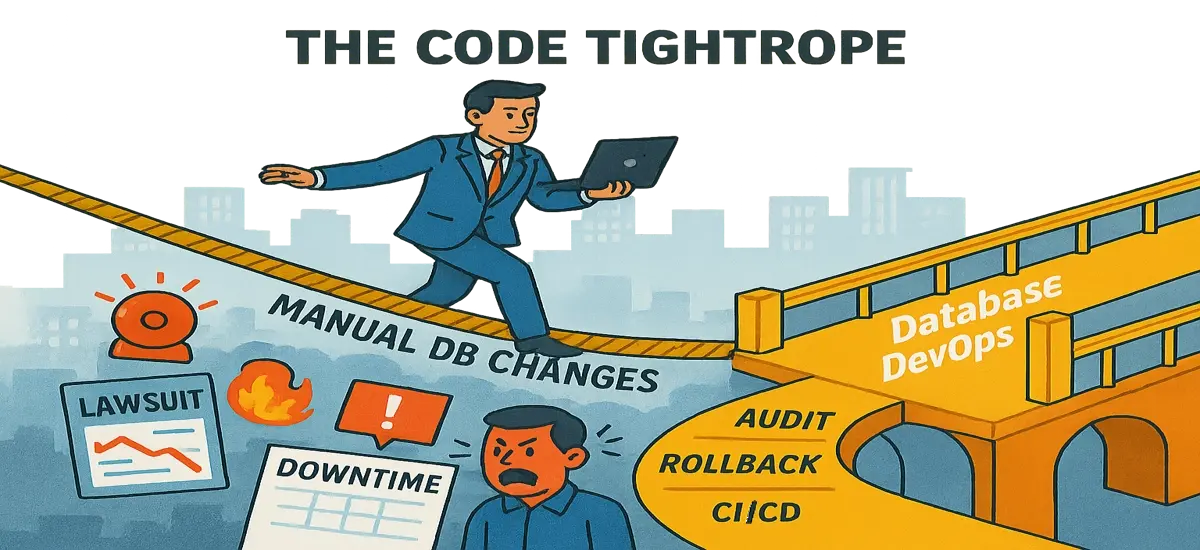
Manual Database Management: A Tightrope

Businesses today walk a tightrope when it comes to managing their databases. Applications evolve quickly, user expectations are higher than ever, and regulators demand compliance without compromise. Yet, many organizations still rely on manual database management to handle schema changes, stored procedures, and deployments.

On the surface, this might seem manageable, but the reality is stark: manual database DevOps is dangerous, risky, and expensive. One wrong step can send a business tumbling into downtime, noncompliance, and customer dissatisfaction.

This article explores the dangers of manual database management and explains how DBmaestro, the leading Database DevSecOps platform, helps organizations move off the tightrope and onto solid ground.

The Dangers of Manual Database DevOps

  1. Human Error – The Constant Threat

Every manual step in a release pipeline is an invitation for mistakes. A missed dependency, a typo in a script, or an overlooked rollback plan can cause catastrophic outages. Unlike application code, which is designed to fail safely in test environments, database changes often execute directly against production data. Errors here can’t simply be undone – they ripple into corrupted data, customer impact, and long downtime.

  1. Environment Drift – When Test and Prod Don’t Match

In a manual process, it’s rare for database changes to move through Dev, Test, Staging, and Production in perfect sync. What works in one environment fails in another, creating endless troubleshooting loops. Environment drift slows down releases and erodes confidence in the release pipeline.

  1. Lack of Governance and Auditability

Regulatory frameworks such as SOX, HIPAA, PCI-DSS, and GDPR all demand clear answers to three questions: who made this change, when, and why? Manual processes struggle to deliver these answers. Scripts circulate by email, DBAs log into production directly, and version history disappears. When auditors arrive, organizations find themselves scrambling.

  1. Bottlenecks in Release Cycles

Agile teams can push application code multiple times a day through automated pipelines. Yet when they reach the database layer, everything slows down. Changes wait in DBA queues, releases get rescheduled, and entire sprints lose momentum. This is why databases are often the bottleneck in CI/CD pipelines.

  1. Security and Identity Risks

Manual processes often rely on shared credentials or direct database access. This opens the door to insider threats, misused privileges, and even identity theft. When dozens of developers, DBAs, and contractors all share the same credentials, there is no way to know who actually made a change or whether it was authorized.

  1. Hidden Costs and DBA Toil

Skilled DBAs spend countless hours on repetitive tasks like running scripts, fixing failed deployments, and reconciling environments. These tasks add little business value but consume critical resources. Over time, the result is higher costs, increased burnout, and difficulty scaling database operations.

DBmaestro: Turning the Tightrope into a Bridge

Walking a tightrope is thrilling for a circus act – but for enterprises, it is unsustainable. DBmaestro replaces manual risk with automated control, enabling organizations to treat database changes with the same rigor and speed as application code. Let’s see how DBmaestro addresses each of the major challenges.

  1. Preventing Human Error

DBmaestro introduces automation and guardrails into every database release.

  • Automated Validations: Scripts are checked for conflicts, dependencies, and potential impact before they ever touch production.
  • Safe Rollbacks: If something does go wrong, DBmaestro provides controlled rollback options, ensuring downtime is minimized.
  • Error Prevention: Built-in policies catch risky changes, such as dropping a critical table or deploying untested code, before they cause damage.

Result: Reduced downtime, fewer outages, and far less firefighting for DBAs.

  1. Eliminating Environment Drift

DBmaestro enforces consistency across environments.

  • Version Control for Database Code: Schema changes, stored procedures, and reference data are stored in Git repositories.
  • Automated Synchronization: Changes flow seamlessly from Dev to Test to Prod.
  • Deployment Pipelines: The same tested change is applied across all environments, eliminating drift.

Result: If it worked in Test, it works in Production – confidence is restored.

  1. Governance and Compliance Built In

DBmaestro provides the governance layer that manual processes lack.

  • Full Audit Trails: Every change is logged, linked to a user, and mapped to a ticket or business justification.
  • Compliance Reporting: Dashboards and reports make regulatory audits straightforward.
  • Policy Enforcement: Changes that don’t meet corporate standards or compliance requirements simply don’t get deployed.

Result: Compliance becomes proactive rather than reactive, reducing the risk of fines or regulatory breaches.

  1. Accelerating Release Cycles

DBmaestro integrates database changes into the same CI/CD pipelines used for applications.

  • Pipeline Integration: Works seamlessly with Jenkins, GitLab, Azure DevOps, and other CI/CD tools.
  • Parallel Releases: Application and database changes move together, eliminating the bottleneck.
  • Metrics and Insights: Delivery performance is tracked with DORA metrics for both application and database layers.

Result: Releases accelerate, keeping pace with business demands and customer expectations.

  1. Securing Access and Identity

DBmaestro enforces strict control over who can change what, and where.

  • Role-Based Access Control (RBAC): Ensures that only authorized users can execute changes.
  • Integrating Secrets Management vaults: Eliminates the need for shared credentials by integrating with vault solutions.
  • Identity Attribution: Every action is linked to an individual user, closing the door on anonymous changes.

Result: Database security strengthens, insider threats shrink, and compliance with identity requirements is guaranteed.

  1. Reducing Toil and Hidden Costs

By automating repetitive tasks, DBmaestro frees DBAs to focus on strategic work.

  • Automated Deployments: No more manual execution of scripts.
  • Self-Service for Developers: Teams can deploy database changes safely without waiting on DBA intervention.
  • Shift to Value: DBAs spend more time optimizing performance, scaling systems, and guiding strategy.

Result: Lower operating costs, reduced burnout, and greater scalability of database operations.

get a demo banner

Why Manual is No Longer an Option

In the past, organizations tolerated manual database management because there was no alternative. Today, with the rise of DevOps, cloud, and regulatory scrutiny, that tolerance is gone. Manual database DevOps is not only slow – it is a liability. Enterprises that fail to automate are left exposed on every front: operational stability, compliance, security, and cost.

DBmaestro is designed to remove this exposure. By automating database release management, enforcing governance, and integrating seamlessly with existing DevOps pipelines, it transforms the tight rope into a wide, secure bridge that carries organizations toward agility and resilience.

Conclusion: From Balancing Act to Competitive Advantage

Manual database management forces organizations into a dangerous balancing act – a tightrope where every step could lead to a fall. Human error, inconsistent environments, compliance failures, bottlenecks, and security risks all conspire to keep enterprises unstable.

DBmaestro provides the balance pole, safety net, and bridge all in one. It brings the principles of DevOps – automation, governance, speed, and security – to the last frontier of software delivery: the database.

Organizations that adopt DBmaestro move off the tightrope and onto solid ground. They release faster, stay compliant, reduce risk, and empower their teams to focus on innovation rather than firefighting. In today’s world, that isn’t just safer – it’s a competitive advantage.

Mind the Map of Mayhem

How Chaotic Database Change Practices Undermine DevOps, and How DBmaestro Charts the Course to Control

In the high-velocity world of modern software delivery, DevOps has become the guiding framework for achieving speed, efficiency, and resilience. Yet, amid the carefully choreographed automation of application code, there exists a forgotten frontier – a tangled mess of manual steps, undocumented workarounds, and risky database changes. This chaotic landscape is what we call the Map of Mayhem.

Most organizations don’t even realize they’re navigating it.

This article explores what the “Map of Mayhem” is in the context of Database DevOps, why it’s dangerously common yet often ignored, and how platforms like DBmaestro help organizations leave mayhem behind and move toward control, compliance, and confidence.

What Is the Map of Mayhem?

The Map of Mayhem is not a literal diagram. It is a metaphor for the disorder, risk, and unpredictability that characterizes how many organizations still handle database changes within their DevOps pipelines.

While application code changes move through controlled CI/CD processes, database changes often follow a completely different path, or worse, no path at all.

Here’s what a typical “Map of Mayhem” looks like:

  • A patchwork of emailed SQL scripts
  • Manual production updates run directly by Developers or DBAs
  • Rollbacks attempted with fingers crossed
  • No audit trail, version control, or unified process
  • Release failures traced back to “someone changed something in the DB”
  • Environment drift between dev, test, and prod
  • Regulatory noncompliance that goes unnoticed until it’s too late

The result? Deployment instability, rework, security risks, downtime and a massive DevOps blind spot.

Why It’s Unseen but Everywhere

Ironically, the Map of Mayhem thrives in shadows. Database change management has traditionally been handled by a small group of senior DBAs or operations engineers who use tribal knowledge and trusted tools (or spreadsheets).

There are several reasons this mess is so persistent:

  • Databases are stateful. Unlike stateless app code, you can’t simply “replace” a database. Changes are cumulative, and mistakes are permanent.
  • Fear of breaking things. Many teams intentionally avoid automating DB changes, assuming that manual control reduces risk.
  • Tooling gaps. While CI/CD tools like Jenkins, GitHub Actions, and Azure DevOps are mature for application code, they lack the native support required for managing DB state and compliance.
  • Lack of ownership. Application teams don’t want to own database changes, and DBAs aren’t DevOps-oriented.

This leads to a false sense of stability. Things might look under control until a failed release, data corruption, or compliance audit reveals the true state of mayhem lurking beneath the surface.

The Consequences of Ignoring the Mayhem

If your organization is still navigating a Map of Mayhem, you’re likely experiencing:

  1. Unstable Releases

Database changes executed outside of pipeline control create unpredictability. Teams can’t reproduce issues, which leads to failed releases and missed deadlines.

  1. High Mean Time to Recovery (MTTR)

Without proper tracking and automation, recovering from failed database changes takes hours or days instead of minutes.

  1. Increased Risk of Data Loss

Manual processes are inherently error-prone. One misplaced semicolon or untested script can cause irreversible data issues.

  1. Regulatory Exposure

For industries under SOX, HIPAA, GDPR, or PCI-DSS, the lack of traceability, approval gates, and role-based access control becomes a compliance nightmare.

  1. No Observability

You can’t measure what you don’t track. Teams flying blind on database performance metrics like deployment frequency, lead time, or failure rates cannot improve.

Why You Must Mind the Map

Just like the iconic “Mind the Gap” warning in the London Underground, “Mind the Map of Mayhem” is a call to awareness.

It is a warning to engineering leaders, DevOps architects, and CIOs. If your database change process isn’t automated, secured, and observable, you’re not truly practicing DevOps.

You’re gambling with your delivery pipeline and your data.

DBmaestro: Turning Mayhem into Measured Control

Enter DBmaestro, the leading Database DevSecOps platform built to bring the same automation, security, and governance principles of DevOps to the often-ignored world of databases.

DBmaestro doesn’t just patch the symptoms of the Map of Mayhem. It replaces it with a smart, compliant, and secure map for controlled change.

Key Capabilities That Tame the Mayhem

1. Automated Database CI/CD Pipelines

DBmaestro enables you to fully integrate database changes into your application delivery pipeline. This includes:

  • Schema and code changes versioned in Git
  • Pipelines that deploy through automated, tested workflows
  • Elimination of manual script copying and guesswork

2. Built-in Security and Compliance

Security is embedded in the process:

  • Enforced role-based access control (RBAC)
  • Change approval workflows and policy enforcement
  • Detailed audit trail capturing who changed what, when, where, and why
  • Adherence to SOX, PCI, HIPAA, GDPR, and FedRAMP standards

3. Drift Management

Drift between environments is one of the most dangerous aspects of the Map of Mayhem. DBmaestro:

  • Detects schema and configuration drift automatically
  • Flags deviations before they cause outages
  • Offers easy resolution with side-by-side comparison and rollback

4. Observability with DORA Metrics

With DBmaestro, you gain full visibility into database performance:

  • Deployment frequency
  • Change failure rate
  • Lead time for changes
  • Mean time to recover (MTTR)

Metrics are broken down by project, environment, or team, enabling data-driven improvement.

5. Rollback and Recovery

Failed changes are no longer disasters. DBmaestro enables intelligent rollback and structured recovery, turning risk into resilience.

DBmaestro Charts the Course to Control

If your current process feels like a handwritten pirate map drawn in panic and reworked in each sprint, DBmaestro gives you a navigation-grade GPS for database delivery.

It replaces guesswork with governance, silos with collaboration, and chaos with compliance.

Here’s what that transformation looks like:

From Map of Mayhem To Map of Mastery with DBmaestro
Ad hoc scripts Git version-controlled pipelines
Manual production changes Automated, gated deployments
No approvals Role-based access and policy workflows
Zero audit trail Full traceability and reporting
Environment drift Real-time drift detection and remediation
Blind spots Metrics, dashboards, observability
Tribal knowledge Standardized, repeatable processes

Real-World Fit

DBmaestro is trusted by major banks, insurance companies, government agencies, and Fortune 500 enterprises. It is especially valuable where compliance, security, and auditability are non-negotiable.

For companies undergoing cloud transformation, adopting hybrid environments, or tightening software supply chains, database change automation is no longer optional. It is essential.

get a demo banner

Final Word: Mind the Map, Master the Journey

DevOps is about shortening feedback loops, increasing confidence, and reducing risk. Yet your database might be quietly sabotaging those goals.

Mind the Map of Mayhem.

Beneath every failed release, security breach, or compliance violation, there is often a database change gone wrong. These changes are undocumented, unapproved, and untraceable.

With DBmaestro, you gain not just visibility but control. You elevate your DevOps practice to include the most sensitive, mission-critical component of all: your data.

And when your database joins the journey, the mayhem ends and mastery begins.


Warning – Database Toil Ahead

Software is never static. Agile teams push changes to production multiple times a day. Features evolve fast, business needs pivot even faster – and at the heart of it all lies the one constant that can either drive or derail your success: the database.

Unfortunately, for most organizations, the database hasn’t caught up with the pace of DevOps. While applications move with speed and agility, databases are bogged down by manual, error-prone, and risk-laden processes. That burden is known as database toil – and it’s more costly than most IT leaders realize.

Let’s break down what this toil looks like, why it’s dangerous, and how to eliminate it for good.

🧱 What Is Database Toil?

In DevOps, “toil” refers to repetitive, manual work that’s automatable and adds little long-term value. Database toil is the set of ongoing manual tasks required to manage schema changes, enforce governance, prevent drift, and align database states across environments.

These tasks aren’t just annoying – they’re dangerous. They lead to:

  • Release delays
  • Production outages
  • Compliance violations
  • Skyrocketing costs

And worst of all? They scale with your system, not your strategy.

🔍 The Core Elements of Database Toil

Let’s walk through the primary components of database toil and why they matter to your business.

  1. Manual Script Management

Most database changes today begin with developers or DBAs hand-writing SQL scripts. These scripts govern everything from adding new columns to changing constraints or altering procedures.

Why it’s toil:

  • Every script needs review, approval, and testing
  • One mistake (like missing a WHERE clause) can bring down production
  • You’re reinventing the wheel for every change

Risks:

  • Delays: Scripts wait in queues for DBA reviews
  • Errors: Manual mistakes slip through
  • Inconsistency: Teams write changes differently, leading to chaos

Example: Imagine three development teams working on the same schema. One adds a column, another drops a deprecated index, the third changes a datatype. Without coordination, these scripts may collide – creating outages, rollbacks, and lost development time.

  1. Environment Drift

In theory, dev, test, and production databases should look identical. In practice, they drift – quickly.

Why it’s toil:

  • Drift happens when a change hits one environment but not another
  • Most teams detect drift manually (or worse, during an outage)

Risks:

  • Bugs: QA passes a feature, but it fails in production
  • Production instability: Hotfixes applied directly to prod never make it back to dev
  • Hidden costs: Engineering time wasted debugging “it worked on my machine” problems
  1. Manual Deployments

Even if your application code is fully automated with CI/CD pipelines, the database often gets deployed manually. That creates a fragile handoff that breaks delivery flow.

Why it’s toil:

  • DBAs manually execute scripts or follow step-by-step Word docs
  • Coordination is needed with multiple teams (QA, security, release)

Risks:

  • Downtime: Delayed deployment = missed SLAs
  • Rollback nightmares: If a change fails, there’s no “undo” button
  • Blocked releases: Teams must wait for DBA availability
  1. Audit & Compliance Overhead

If your organization is subject to SOX, GDPR, HIPAA, or internal audit requirements, tracking who made which change, why, and when isn’t optional.

Why it’s toil:

  • Audit trails are manually maintained in spreadsheets or ticketing systems
  • Changes require multi-step approvals and email chains

Risks:

  • Compliance fines: Missing documentation or improper approvals
  • Business risk: No visibility into unapproved or rogue changes
  • Executive blind spots: Inability to report or explain past changes when needed
  1. Rollback & Recovery

Application teams can often roll back code by reverting a commit. For databases, rolling back means manually writing an “undo” script – and praying it works.

Why it’s toil:

  • Every rollback is custom
  • Recovery is reactive, often in high-stress moments

Risks:

  • Downtime: Recovery can take hours
  • Data loss: Schema changes often include irreversible data changes
  • Customer impact: Poor incident response damages trust and revenue
  1. Collaboration Silos

Database changes are typically treated as “sensitive,” meaning only DBAs can handle them. Meanwhile, developers are left in the dark.

Why it’s toil:

  • Creates bottlenecks
  • Limits agility
  • Encourages workarounds (e.g., bypassing processes to “just get it done”)

Risks:

  • Poor accountability: No one owns the change end-to-end
  • Slower time to market: Database becomes the bottleneck in every release
  • Low morale: Frustration builds when innovation is slowed

🧨 The Consequences of Ignoring Database Toil

If you don’t address database toil, you will feel the impact – not just in IT, but across the business:

Consequence Description
Slower Releases Manual reviews and approvals delay sprints
Increased Downtime Mistakes during manual deployments lead to outages
Compliance Gaps Manual logs and approvals don’t stand up to audits
Developer Burnout Waiting on DBAs kills momentum and morale
Lost Revenue Every delayed or failed feature is a missed business opportunity

🚀 Enter DBmaestro: From Toil to Flow

Now that we’ve diagnosed the problem, let’s talk about the cure.

DBmaestro is a database DevSecOps automation platform built to eliminate database toil from end to end. It integrates with your DevOps toolchain to make database changes as smooth, safe, and fast as application code changes.

Here’s how:

  1. Pipeline-Ready Database Automation

DBmaestro turns database changes into version-controlled, pipeline-ready artifacts. Developers commit changes via Git, just like code.

  • Impact: No more manual script handoffs
  • Result: Developers and DBAs speak the same language

Example: A developer commits a schema change, which DBmaestro automatically validates, tests, and promotes through staging to production – all with proper approvals.

  1. Drift Prevention & Environment Sync

DBmaestro tracks schema differences between environments and prevents changes that introduce drift.

  • Impact: Confidence that dev, test, and prod are aligned
  • Result: No more “worked in staging” surprises
  1. Audit, Approvals & Compliance – Built-In

DBmaestro captures every change, approval, and action with full traceability.

  • Impact: Always audit-ready
  • Result: Avoid compliance risks without extra effort

Bonus: Approvals can be tied to JIRA tickets or ITSM workflows – so changes only proceed when governance criteria are met.

  1. Safe Rollbacks

DBmaestro enables rollback automation by versioning database states and allowing safe undo of unwanted changes.

  • Impact: Outage recovery in minutes, not hours
  • Result: Minimized customer impact and reduced downtime costs
  1. Real Observability

Using metadata and DORA-aligned metrics, DBmaestro offers deep insights into your release velocity, change failure rate, and environment health – specifically for the database.

  • Impact: Make data-driven decisions
  • Result: Know where bottlenecks are and how to fix them
  1. Collaboration & Control

DBmaestro empowers dev teams while keeping DBAs in control. It supports role-based access, separation of duties, and policy enforcement.

  • Impact: Shared responsibility without chaos
  • Result: Move fast, stay safe

📈 The Business Impact

Eliminating database toil isn’t just a technical win – it’s a business accelerator.

Benefit Business Outcome
Faster Time to Market Launch new features sooner
Reduced Downtime Protect revenue and reputation
Higher Developer Productivity Build more with the same team
Stronger Compliance Posture Avoid fines and pass audits
Improved Cross-Team Collaboration Break silos, streamline delivery

get a demo banner

🎯 Final Thought: Toil Is a Choice – Automation Is the Way Forward

Application DevOps has already proven its worth. Now it’s the database’s turn.

Database toil doesn’t scale, doesn’t innovate, and doesn’t win markets. The longer you allow it to persist, the more friction, risk, and cost you absorb into your delivery pipeline.

With DBmaestro, you can flip the script – turn manual chaos into structured automation, eliminate bottlenecks, and unlock a higher-performing business.

Your apps are agile. Your database should be too.

IBM and DBmaestro Expand Strategic OEM Partnership to Deliver Enterprise-Grade Database DevOps and Observability

Orlando, FL, July 1, 2025 — IBM (NYSE: IBM) and DBmaestro, the leading enterprise-grade database DevOps platform, today announced the signing of a landmark OEM partnership agreement. This expansion will make DBmaestro’s advanced database DevSecOps and observability suite available through IBM’s solutions portfolio, empowering customers to achieve end-to-end DevOps automation, real-time database visibility, and unmatched agility, security, and innovation.

“DBmaestro’s platform will support and enhance IBM DevOps, including IBM DevOps Loop, IBM DevOps Deploy and IBM DevOps Velocity. Future integrations are planned with IBM Z, HashiCorp Vault, Terraform & Waypoint, Instana, and IBM ELM to fill a critical gap in database automation and observability for enterprise DevOps toolchains.”

“The expansion from reseller to a full OEM partnership marks a pivotal moment for enterprise DevOps,” said Gil Nizri, CEO of DBmaestro. “By integrating our leading enterprise-grade multi-database DevOps platform and observability suite into IBM’s powerful suite, we are enabling organizations to orchestrate flawless software delivery from application code to database deployments. Our joint solution empowers customers to accelerate innovation, reduce risk, and maintain the highest standards of security and compliance, all while gaining real-time visibility into their database processes.”

James Hunter, Program Director at IBM DevOps Automation (left) with Gil Nizri, DBmaestro CEO

DBmaestro automates database deployments and schema changes, eliminates the bottleneck of manual database processes, and delivers full observability into every aspect of the database DevOps lifecycle. Its integration with IBM’s DevOps tools ensures that database changes are managed alongside application code, enabling standardized deployment pipelines, robust version control, error-free automation, and actionable insights through advanced monitoring and analytics. This unified approach delivers:

– Complete DevOps Harmony: Automates the entire software delivery lifecycle, including database releases and observability for full modernization and digital transformation.

– Faster Time to Market: Enables rapid, frequent, and reliable deployments.

– Fortified Security and Compliance: Implements robust controls and visibility to meet strict regulatory requirements.

– Enhanced Software Quality: Minimizes errors and inconsistencies through automation and real-time monitoring.

– End-to-End Observability: Provides comprehensive insights into database changes, performance, and compliance across environments.

– AI Powered Insights: Automatically identifies errors and proposes ad-hoc best practices for resolution

“IBM’s mission is to help enterprises deliver innovation at scale, securely and efficiently,” said James Hunter, Program Director at IBM DevOps Automation. “By embedding DBmaestro’s industry-leading database DevOps and observability suite into our ecosystem, we are removing one of the last barriers to true end-to-end DevOps. This partnership expansion empowers our customers to achieve faster, safer, and more reliable software delivery, with unprecedented transparency into their database operations.”

The OEM agreement allows IBM customers to leverage DBmaestro’s automation and observability as a native part of their DevOps toolchain, supporting hybrid and multi-cloud environments and streamlining complex database operations.

Media contact:

Ben Gross

+972-50-8452086

[email protected]